What is a GTM engineer? The new growth hacker and how to become one in 2027
GTM engineering is a new way of doing marketing, bigger than sales support. One person builds the systems that find, win and keep customers. The job, tools, pay and how to start.
By Rabin Nuchtabek · Updated 2026-11-24 · 32 min read · For Must know, Builders, Marketers, Leaders
A GTM engineer (go-to-market engineer) is the growth hacker who can build. One person makes the systems a company uses to find, win and keep customers: the lists, the data, the scoring, the outreach and the routing that a team used to do by hand. It is more than sales support. It is a new way of doing marketing. Clay invented the title in 2023. By 2026 it was a job with its own salary surveys, its own courses and its own arguments.
This guide goes over three things: what a GTM engineer is, how to become one in 2027, and why you would want to. Around those it covers the systems, the skills, the method, the tools, the rules and the pay. The short version of the skills: be T-shaped, with range across the whole funnel and depth in one craft. Every fact was checked at its source: the job market on 19 November 2026, the growth history and method on 23 and 24 November. It is long on purpose, so use the menu to jump to the part you need.
What is a GTM engineer?
A GTM engineer is the person who builds and automates the systems behind sales and marketing, so a small team can find, research and reach the right buyers without doing each step by hand. GTM stands for go-to-market: everything a company does to win and keep customers.
GTM engineering is the practice. Clay's guide defines it as building automated revenue systems with AI, data and workflow automation, and adds the line that matters most: the unit of work is a system, not a task.
Clay describes three layers, each resting on the one before:
- A data foundation. Enrich the records, merge the duplicates, decide who owns what.
- A data model. Scores and researched facts that say which accounts matter.
- Activation. Drafted outreach, lead routing and updates written back to the CRM.
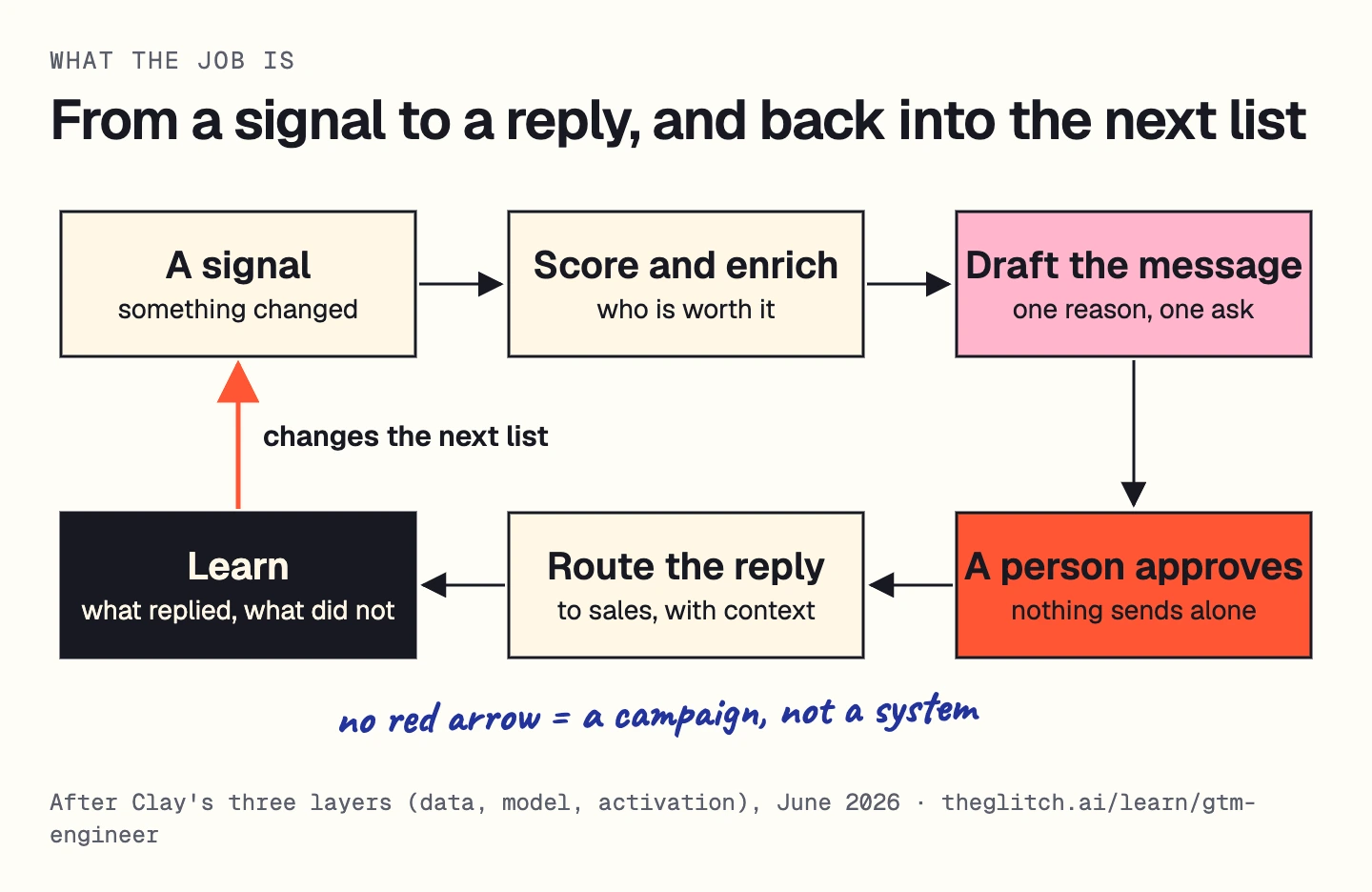
Three things separate the job from ordinary sales operations:
- It builds what does not exist yet. Keeping the CRM tidy is one job. Building the system that scores every new account overnight is this one.
- It works in code, or close to it. APIs, webhooks, SQL and coding agents, more than admin screens.
- It is judged on revenue. Meetings, pipeline and speed to a new lead, not tickets closed.
The same job goes by other names: go-to-market engineer, GTM systems engineer, revenue engineer and, at some companies, growth engineer. Clay shortens it to GTME.
Where did the GTM engineer come from?
The title came from Clay, the data and automation company, which gave it to an internal role in 2023. Clay's own account says its founders coined "Go-to-Market Engineer" that year and that Yash Tekriwal, an early employee, was the first to hold it. He had started by automating his own job, beginning with a form that qualified prospects and replied within minutes.
The work is older than the name:
- It used to need scarce people. Matteo Tittarelli's history of the role says that automating go-to-market once meant hiring growth engineers, who were costly and hard to find.
- Money got tight. The same piece ties the role to 2023, when investors pulled back and startups had to win more revenue with fewer people.
- The tools caught up. Between 2023 and 2024, low-code products such as Clay let a semi-technical person build what had taken an engineering team.
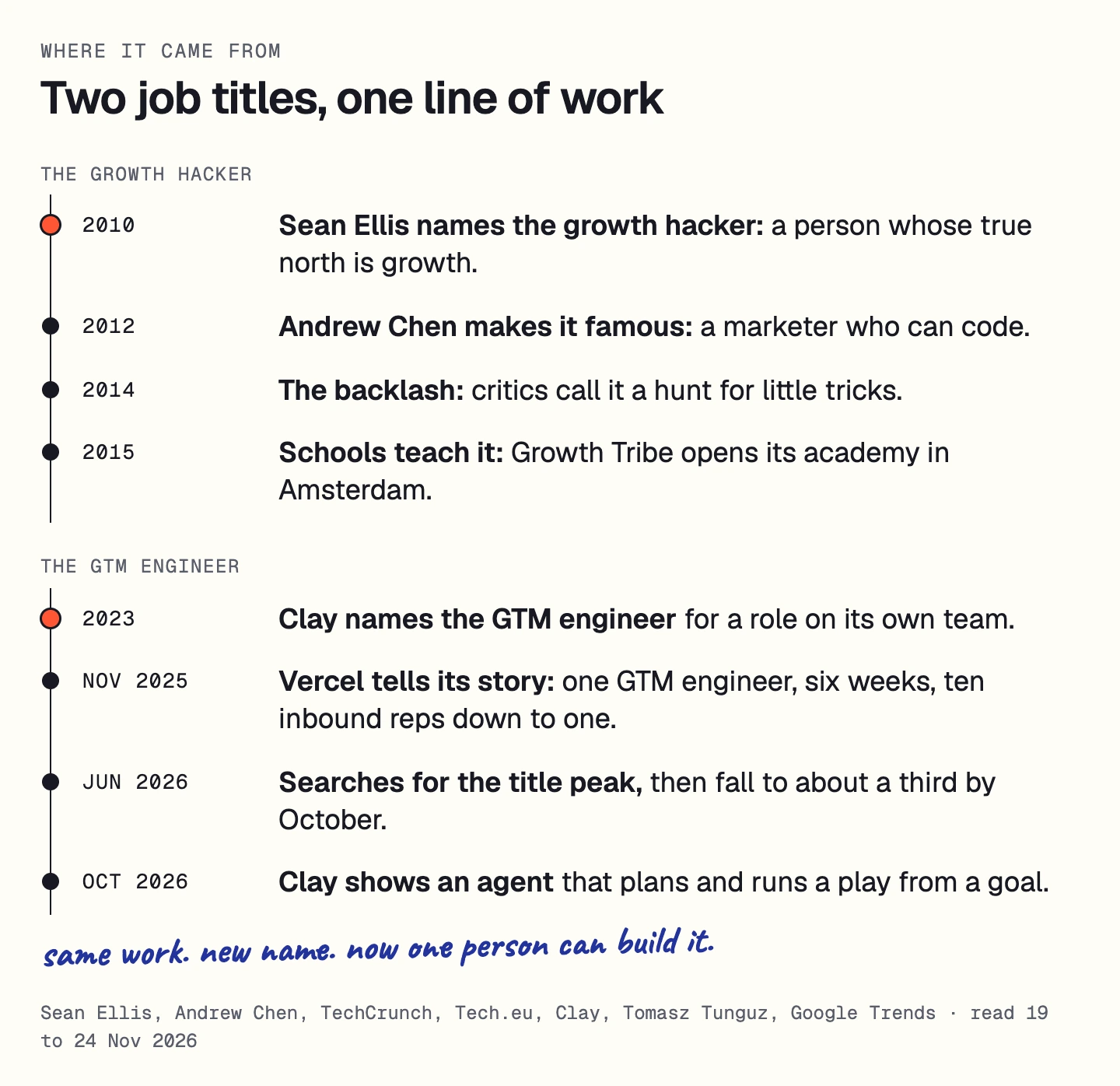
Then it spread, in Clay's telling from its own team to its customers and then to its competitors. In September 2026 Clay raised $115 million at a $7.1 billion valuation and put $1 million into a scholarship fund to train GTM engineers. The Next Web reports that thousands of people now work under the title. A month later, at its Sculpt conference, Clay showed an agent that plans and runs plays from a goal.
Not everyone accepts that the job is new. Barb Mosher Zinck argued in Diginomica that it is marketing and sales operations thought through again, not a new profession. She quotes Simon Daniels, who compares it to "data scientist": a new name for a deeper version of an analyst's job. She does not think that is a bad thing.
Both views can be true. The work existed. The name gave it a budget line.
Is the GTM engineer the new growth hacker?
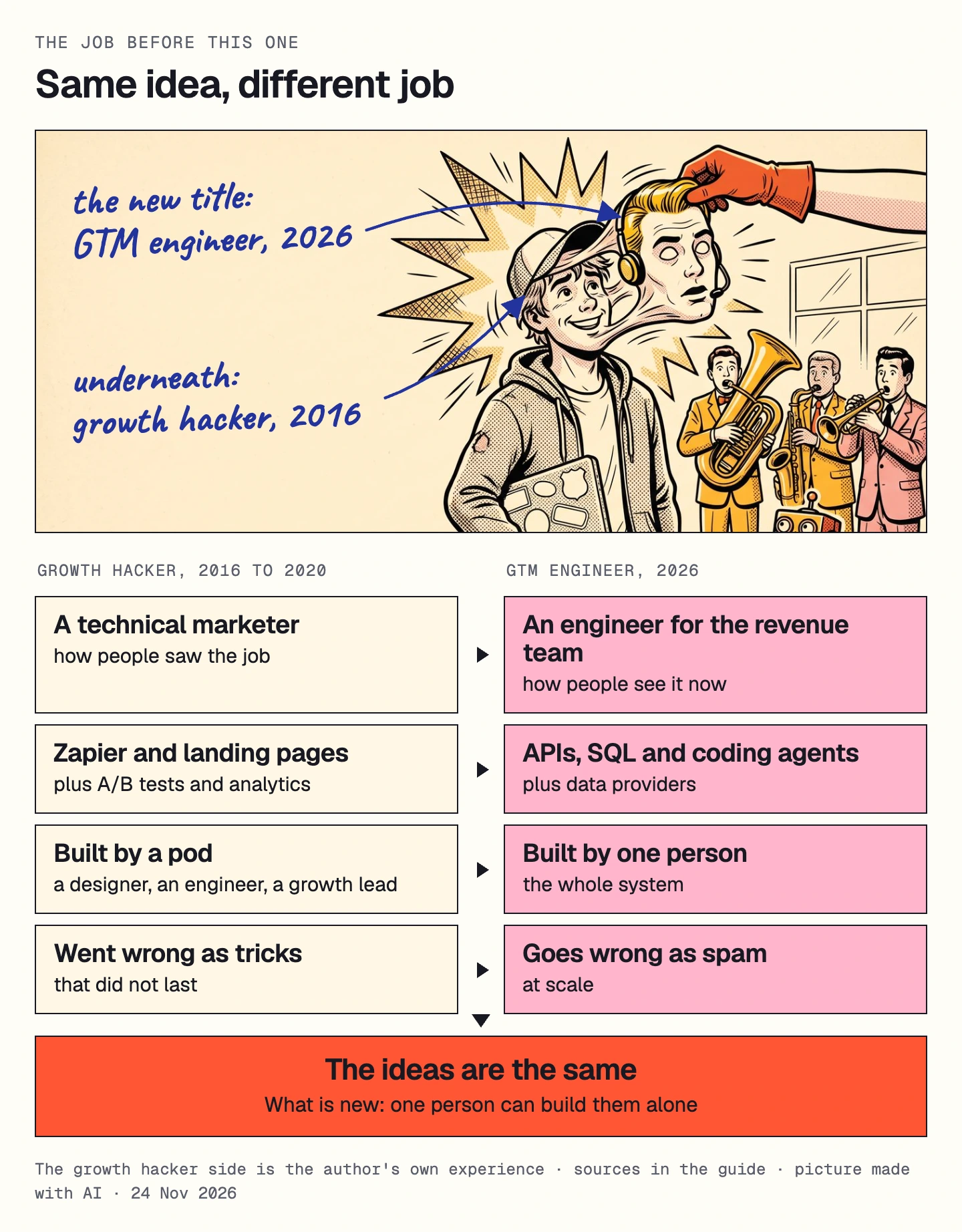
Mostly, yes. Part of the title is a reskin: the funnel, the method and the weekly test are the growth hacker's. The part that is new is one person building the whole system alone, with coding agents. A growth hacker usually needed a team to build the thing, or built a small version alone.
The growth hacker came first. In 2010 Sean Ellis wrote Find a Growth Hacker for Your Startup, the post the title is traced to. His test for the hire: "a person whose true north is growth". In 2012 Andrew Chen made the title famous with Growth Hacker is the new VP Marketing, describing a hybrid of marketer and coder.
By 2014 the backlash had arrived: a TechCrunch essay quotes practitioners who dismiss growth hacking as a hunt for little tricks. By 2015 schools taught it: Growth Tribe opened what it called Europe's first growth hacking academy in Amsterdam, as Tech.eu reported.
People saw the job as a technical marketer. The method was sound: pick one number, run a test every week, keep what moves the number. The limit was hands. Anything deeper than a landing page and a few automations needed a designer and an engineer.
I did this job under its old name
I did a lot of growth hacking myself, on more than 40 projects:
- On missions. A growth hacking agency sent me on missions to Spotify, Tinder and other companies. Companies that size had the resources for real growth teams and pods.
- In a pod. Never one fixed template. Usually a growth lead, a designer and, when there was resource for one, an engineer. The setup shifted sprint by sprint, with the experiments we had put first. Sometimes I led a few squads.
- Alone. In smaller companies there was no pod. It was just me, sometimes with a freelancer, owning all of marketing with Zapier and a bunch of tools.
- As growth lead. I owned the priorities and the experiments, and I bridged every gap when no engineer or designer was free.
- The method. I worked the pirate funnel a lot: AARRR, for acquisition, activation, retention, referral and revenue. And product-led growth, where the product does the selling.
- Across kinds of business. Mobile apps and games, e-commerce, B2B software, crypto, car rental at UFODRIVE. Corporates too: the innovation hubs of companies like P&G, a business school (Solvay in Brussels) and a private bank (Degroof Petercam).
- The pace. Alone, I could only ship something every week or two. What I used to do with a team in a month, I can now do in a matter of hours. One person can now ship what used to wait on pod resources.
The rest of that story is on the about page.
What changed
- A coding agent writes the script. The person describes the job and checks the result.
- The data answers through an API. No one copies rows between tools by hand. The scoring and the research run in SQL, Python, n8n, Clay and coding agents, and write the result back to HubSpot or Salesforce.
- One person builds the whole system. Vercel is the case everyone cites. The story is in the next chapter.
Is it more than sales support?
Yes. It is bigger than business development or sales support. It is a new way of doing marketing.
- Marketing used to be campaigns. A team planned one, built it by hand and ran it for a quarter.
- Now it is systems. One person builds the thing that picks who to talk to from a signal, writes for that one account and learns from every reply.
- The craft is still marketing. Who is the customer, what do they care about this week, what do we say, did it work.
The title does get stretched the other way. I saw it myself: at some companies "growth hacker" or "growth manager" meant a business development role. The same is happening here: at small companies the title is often an outbound sales job with new tools. That is the small version of the idea. A sales development rep works a list. A GTM engineer builds the system that makes the list.
What the growth hacker's story predicts
- The word wore out. The work stayed. By 2014 critics were already calling growth hacking a hunt for tricks. Teams kept running the tests anyway.
- It happened to the prompt engineer too. In May 2025 Fortune reported that the title had not taken off: prompting had become a skill every worker needs. Searches for the role on Indeed had peaked in April 2023.
- The same split has started here. Kenny Damian describes people who run the tools and people who build them. The builders are paid more.
A title can fade. A person with range and one deep craft keeps the work. That is the T-shape.
Why are companies hiring GTM engineers?
Companies hire them because the old way of growing, adding sales reps who work lists by hand, got more expensive and less effective at the same moment that building got cheap.
The numbers, each from a different counter:
- Pave: the share of companies with a GTM engineer on the payroll rose from under 0.1% in January 2023 to 3.2% in September 2026, in data Clay published.
- Bloomberry: new GTM engineering postings rose 205% between the first nine months of 2024 and the same months of 2025, in Henley Wing Chiu's analysis.
- Sumble: GTM engineering headcount doubled in a year at US digital-native companies, to more than 400 people, while new postings for sales development reps fell 21%, as Kyle Poyar reported in May 2026.
- Clay: about 100 GTM engineering listings go live each month, by its own count in June 2026.
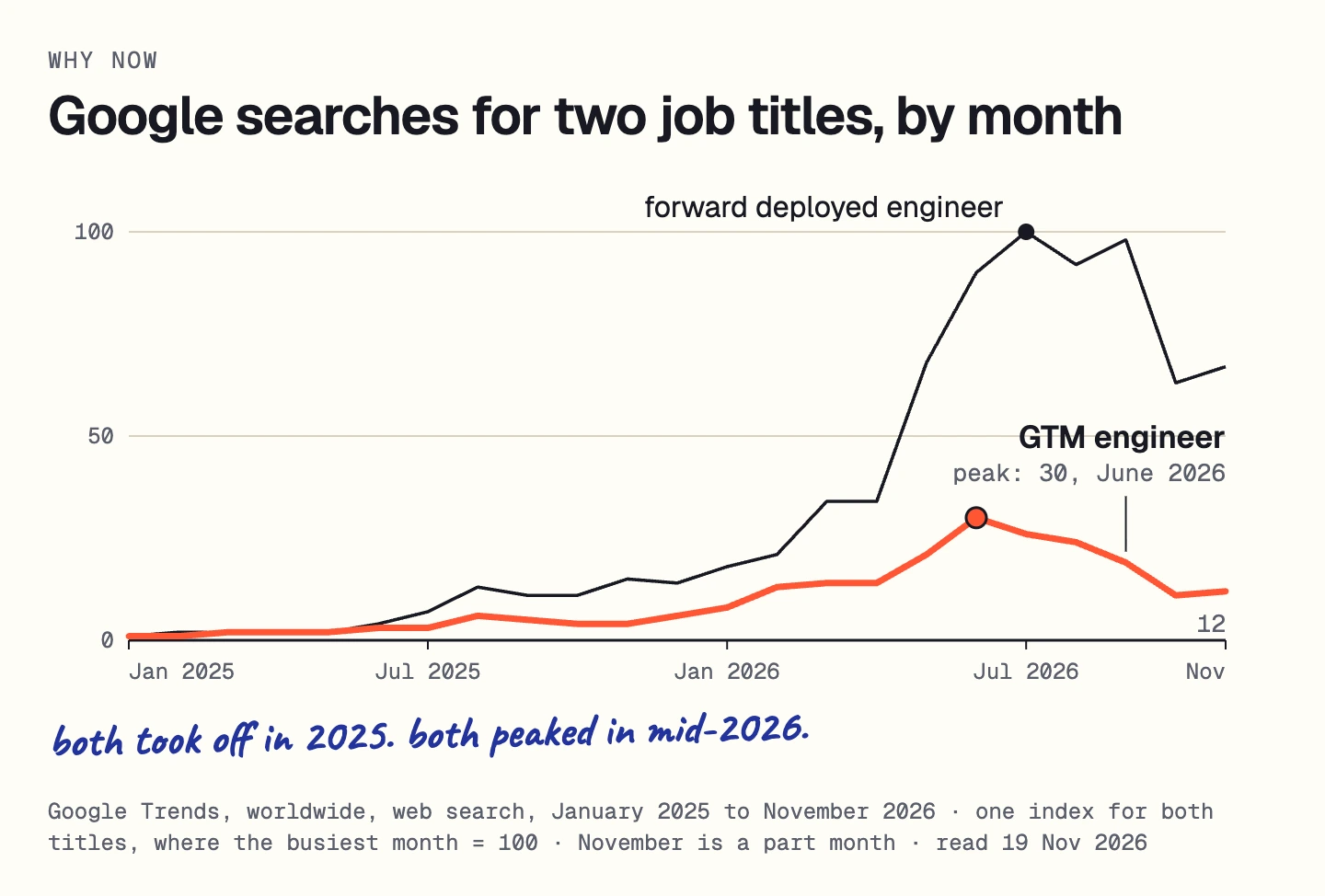
Search interest tells the same story with a twist. In Google Trends, searches for "GTM engineer" were close to zero until 2025 and peaked in June 2026. By October they were at about a third of that peak. The neighbouring title, forward deployed engineer, drew about three and a half times as many searches across 2026.
Two cautions. Do not add the counts up: each firm defines the role its own way, and one includes RevOps. And the market is small: a few hundred people at US software companies, by Sumble's count.
What changed underneath
Three things made the job possible, and then necessary:
- Research got cheap. An AI agent can read a company's site, its job posts and its funding news in seconds. A person used to do that by hand, one account at a time.
- Inboxes got strict. Since February 2024, Google and Yahoo have made bulk senders prove who they are and keep spam complaints low. Sending more of the same stopped working. The rules are set out below.
- One builder can replace a queue. Vercel is the case everyone cites.
Tomasz Tunguz recounts the Vercel story from what its operating chief, Jeanne DeWitt Grosser, said on Lenny's Podcast. One GTM engineer, giving it about a quarter of his time, built an agent to handle inbound leads. After six weeks Vercel went from ten inbound sales development reps to one, who checks the agent's work. The other nine moved to outbound. Conversion from lead to opportunity held flat.
The running cost is small: about $5,000 a year in SaaStr's account, single-digit thousands in Tunguz's later one. The accounts differ on details. They agree on the shape.
What does a GTM engineer do?
Day to day, a GTM engineer finds where the revenue team loses time or misses buyers, builds a system that fixes it, and keeps that system honest with data.
Everett Berry, interviewed as Clay's head of GTM engineering in May 2026, gives the order he works in:
- Fix the data. Nothing built on wrong records works.
- Automate what is broken. The manual steps people already hate.
- Then build new plays. Only once the first two hold.
He describes the job as removing the technical limits that stop a company growing as fast as it could. The shortage, he says, is rarely ideas.
The week is four things: talking to sales and marketing, so the system matches how deals are really won; data plumbing between the CRM, the product database, the data providers and the email tool; building workflows, scripts, prompts and agents; and checking what the system sent and scored. Clay's hiring guide puts strong communication first among the things it tests.
What systems does a GTM engineer build?
A GTM engineer builds systems across the whole funnel. Outbound email is the best known. It is one of five, and all five run on the same core: clean records and dated signals.
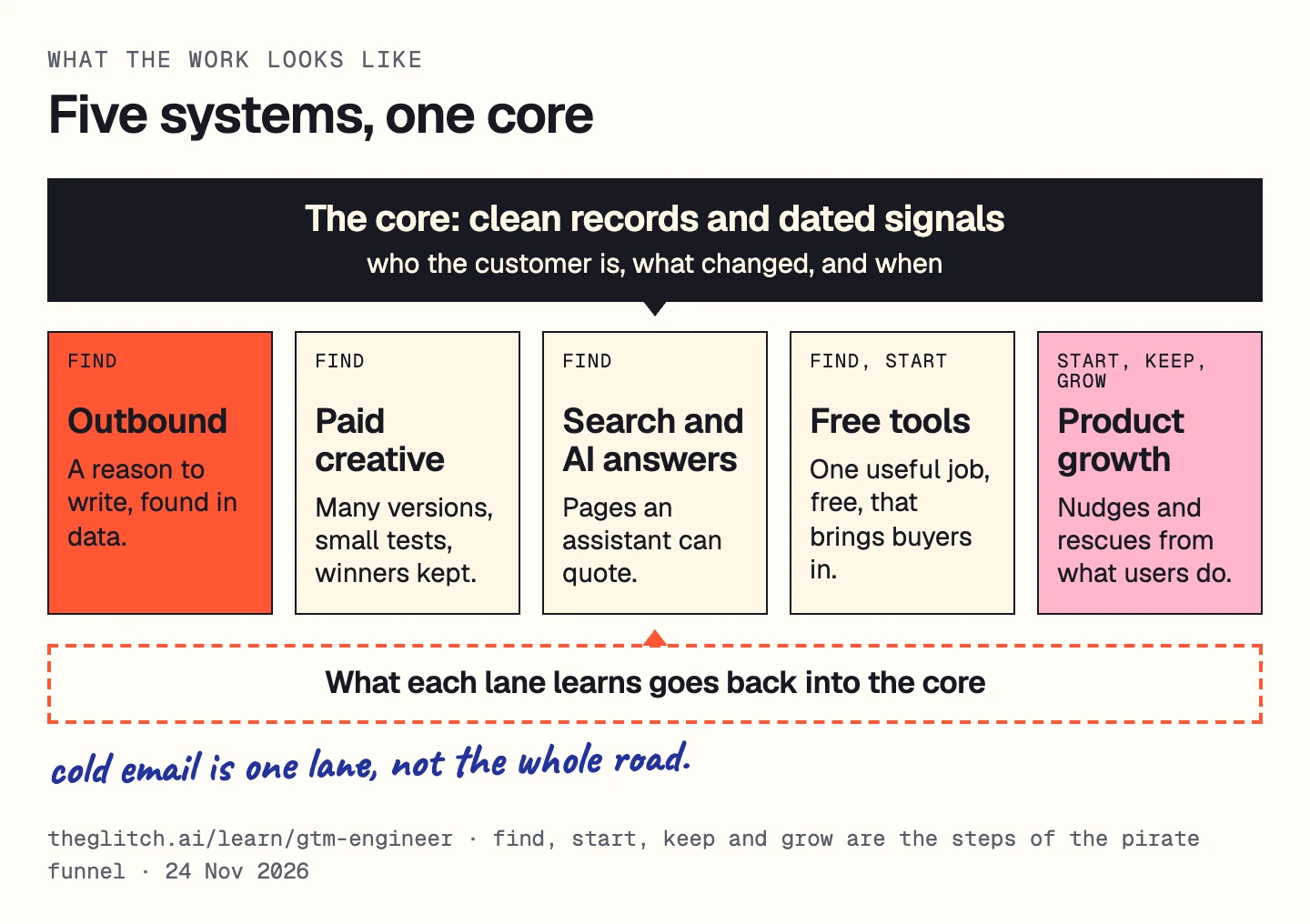
Outbound
A reason to write, found in data. Kenny Damian, who runs outbound for clients at the agency Frontal, names five parts in the order he would build them: scoring each account with a one-line reason, enriching only the ones worth it, saving signals with a date and a source, routing replies to a person who signs off, and one report a day with bounce and spam rates first.
Paid creative
Ads are a test loop. Take the customer's own words, make many versions of the picture and the line, pay for a small test, keep the winners and feed them into the next batch. The image and video guide covers the making.
The same list can feed the ads. LinkedIn takes an uploaded list of companies or contacts as an audience, and Google does the same with a customer list. Both apply their own consent rules.
Search and AI answers
Pages that each answer one question, built from data, with every fact checked. Buyers now ask an assistant before they answer an email, so the page has to be one an assistant can quote and an agent can use.
This site is my own example: more than 250 glossary terms, a weekly checked news digest and lookups an agent can call. Getting cited by AI search, writing content AI will quote and what WebMCP is show how it is built.
Free tools
A small free tool that does one useful job and brings in the people you want. HubSpot's Website Grader is the classic: a free tool launched in February 2007 and used by more than 125,000 organisations by that October, in the company's own count. A coding agent makes a tool like that cheap to build.
Product growth
Watch what people do in the product and act on it: a nudge when setup stalls, a note to a sales rep when usage jumps, a rescue when it drops. This is the activation, retention and referral part of the pirate funnel, and it is where product-led growth lives. One of the case studies Clay sets in its interviews is of this kind: building renewal signals for reps.
Outbound is only half of it
Most public writing about the job is about cold email, because agencies write it. Inside larger companies the work is wider.
Bitscale's analysis of 1,000 job posts found that at companies under 50 people, nearly 90% of GTM engineer roles were outbound outreach. At companies over 1,000 people the share was under 40%.
The rest is inbound and upkeep. Clay's own examples are of this kind: routing a new lead to the right person in real time, filling the CRM from call transcripts, and scoring leads as they arrive.
GTM engineer vs RevOps vs SDR
RevOps keeps the existing revenue systems running, a sales development rep works the list, and a GTM engineer builds the system that makes the list.
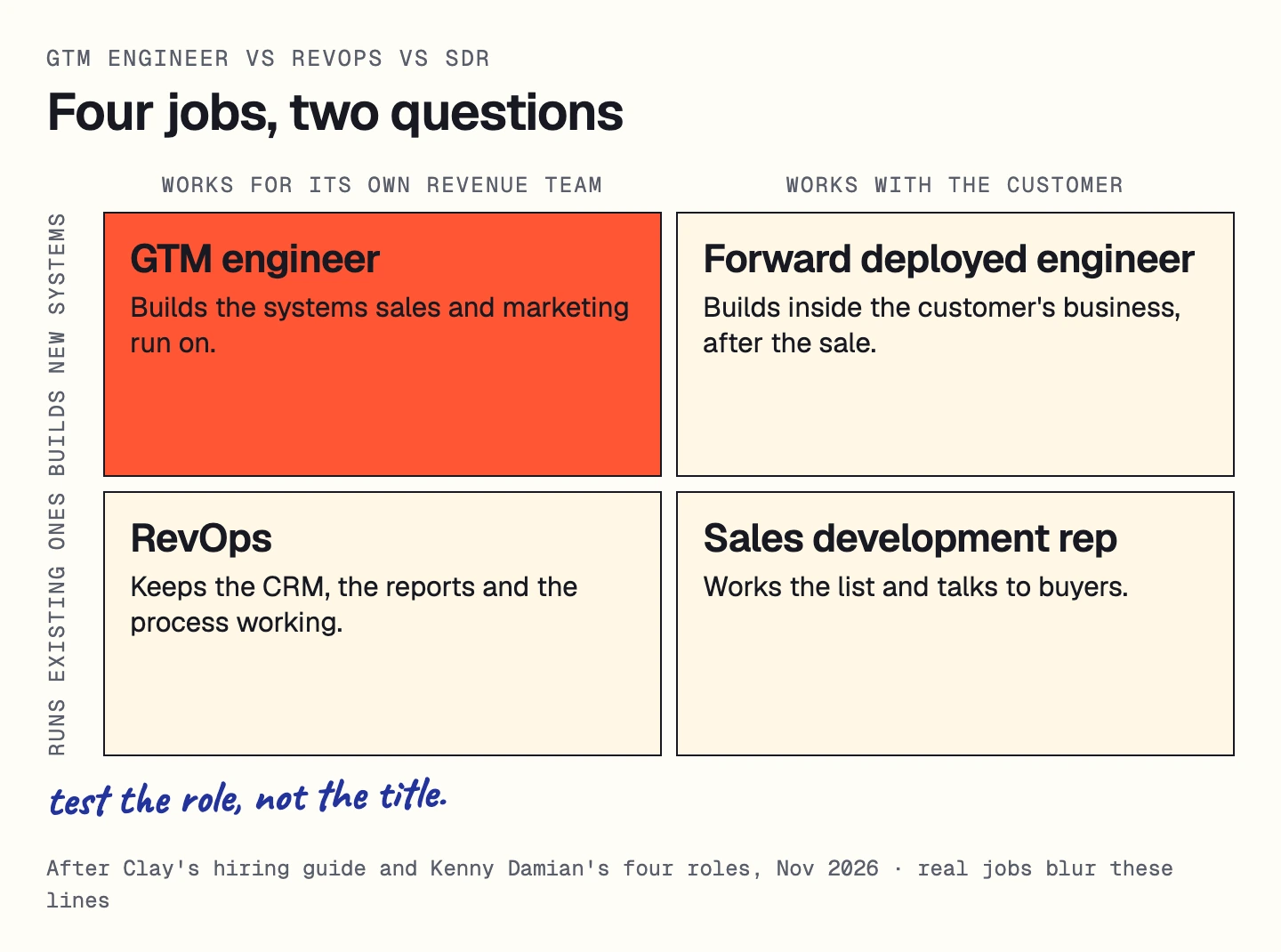
The neighbours, one by one:
- RevOps (revenue operations). Owns the CRM, the reports and the process. Many GTM engineers sit inside it, and Clay places its own in GTM operations. In the Pave data Clay published, GTM engineers earn 24.7% more than RevOps staff and 6.4% less than software engineers.
- SDR (sales development rep). Books meetings from a list someone else built.
- Growth marketer. Runs campaigns, ads and landing pages. The GTM engineer builds the data and automation those campaigns use.
- Growth engineer. The older title this job grew out of. Some companies still use it for the same work.
- Sales engineer or solutions engineer. Explains and demos the product to a buyer before the sale.
- Forward deployed engineer. Builds inside a customer's business after the sale. The two are cousins: one builds for its own revenue team, the other for the customer's. The forward deployed engineer guide covers that job.
The title gets stretched. At a small company, a GTM engineer advert is often a sales development job with new tools. So test the role, not the title:
- Does it build systems other people use?
- Does it own the data those systems run on?
- Is it measured on pipeline, not on activity?
Three yeses is the real job. One is a sales rep with a new badge.
What skills does a GTM engineer need?
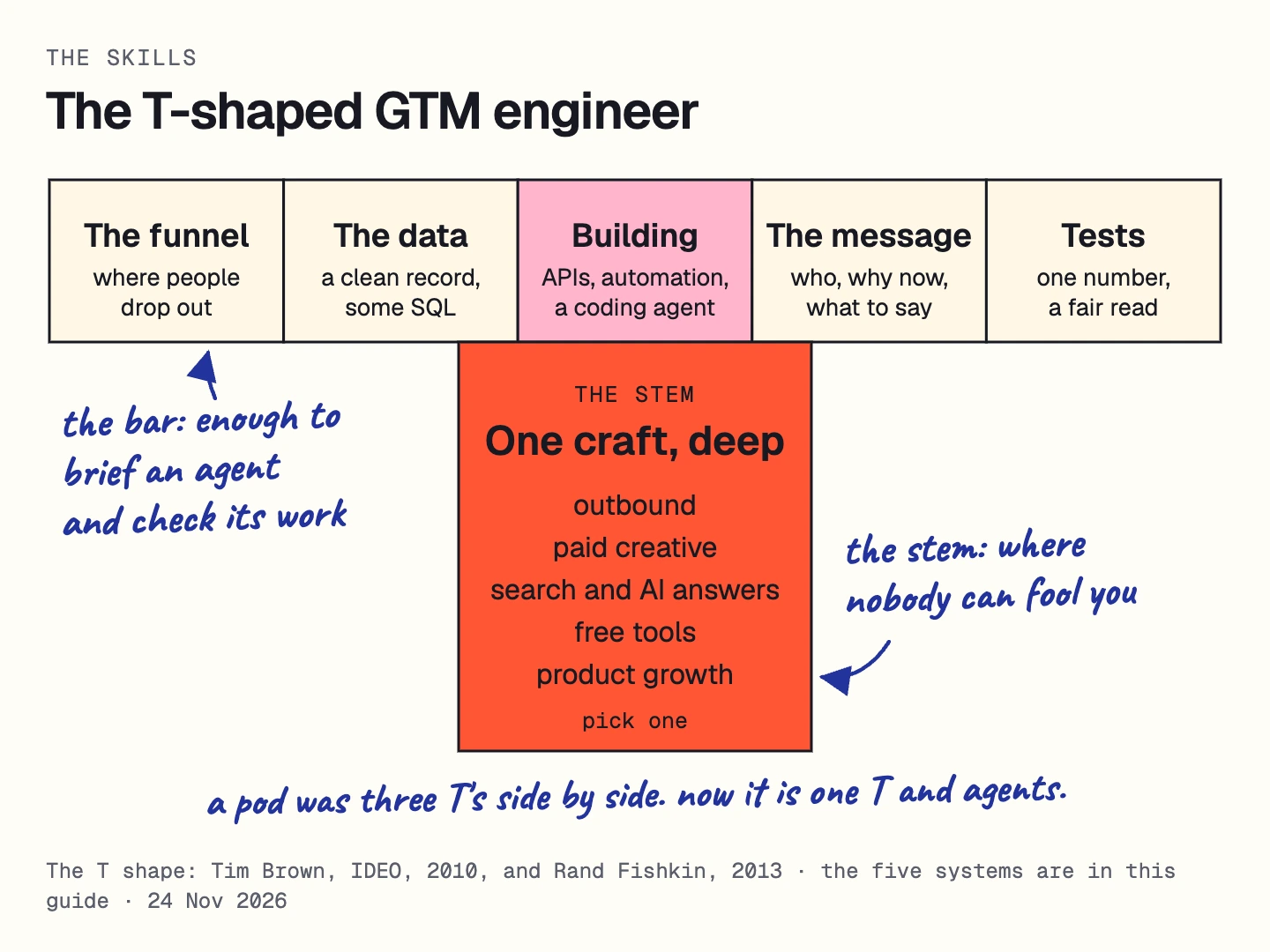
A GTM engineer needs to be T-shaped: enough range to work the whole funnel, and one craft deep enough that no tool and no agent can fool them.
The idea is older than the job. In 2010 Tim Brown of the design firm IDEO described the people it hires as T-shaped: the vertical stroke is depth in one skill, the horizontal stroke is the reach to work across the others. In 2013 Rand Fishkin drew the same shape for web marketers: a light working knowledge of many skills, and deep ability in one or a few.
The bar: enough to brief and check
Five things, none of them at expert level:
- The funnel. Where people drop out between the first visit and the second payment.
- The data. What a clean record is, and enough SQL to ask your own questions.
- Building. APIs, webhooks, an automation tool and a coding agent.
- The message. Who it is for, why this week and what to say. One reason, one ask.
- Tests. One number, a guess written down first, and a fair reading of the result.
In a growth pod the bar was other people: the designer and the engineer. As growth lead I bridged every gap when one of them was missing. Agents now do most of that hands-on work. Knowing what good looks like is still yours: you need enough of each to brief an agent and to see when its work is wrong.
What the job posts ask for is the building part of the bar:
- SQL and Python. Each appears in 38% of postings in Bloomberry's sample. In the 433 US roles Steven Moody checked by hand in 2026, SQL appears in 47% and Python in 45%.
- APIs and webhooks. Clay asks for at least one of Python, JavaScript, SQL or TypeScript, plus APIs and webhooks. It does not ask for a computer science degree.
- Coding agents. Poyar's reading of the Sumble data is that Claude Code is becoming the go-to tool for the role. Claude Code best practices, context engineering and agents for growth teams are the guides to start with.
The stem: one craft, deep
Pick one of the five systems and know it well enough that nobody can fool you. Kenny Damian's warning is that the tools will happily build a perfect list of the wrong people. The stem is what notices.
- The best-known stem is outbound. That is the GTM engineer most people picture, and at small companies it is most of the job posts.
- A stem can cut across the systems. Mine was the growth lead's: deciding what to test next, and running the test.
- The market pays for depth in building. In Moody's salary data, the more software engineering in the role, the more it pays.
What holds it together
Three habits keep the data clean, the sending legal and the numbers honest:
- One record per company and per person, with a rule for which source wins.
- A log of where every contact came from.
- A measure agreed before the build. How to measure AI ROI has the method.
How do GTM engineers run growth experiments?
They run the loop growth teams have run since the 2010s: pick one number, find where the funnel leaks, rank the ideas, write down what a win is, ship a small test and read it honestly.
- One number. Sean Ellis calls it the north star metric. In a 2018 interview he says it tries to quantify the value customers get over time. The examples there are nights booked for Airbnb and daily active users for Facebook.
- Find the leak. Dave McClure's pirate metrics split the funnel into five steps: acquisition, activation, retention, referral and revenue. Work on the step that loses the most people.
- Rank the ideas. Growth Tribe's G.R.O.W.S. loop, as Ward van Gasteren sets it out: gather ideas, rank them, outline the experiment, work, study the result. A simple score such as ICE (impact, confidence, ease) does the ranking.
- Expect to lose. The same write-up puts a beginner's hit rate at about one test in ten, and an experienced team's at about one in three.
How I ran it
This is from the growth wiki I kept for one of my teams:
- A card before any build. The step of the funnel, the hypothesis, how long it runs, what it costs in money and days, and one line that starts "We are right if".
- Sprints of four weeks. Two to build, two to collect data.
- A budget per experiment. An idea over budget got a quick and dirty version first.
- Ideas from anyone. The growth team scored them and kept the list.
- A weekly share. What we learned went to the whole company.
- Three rules. Whatever you do, launch it: you can clean it up later. Find the 20% that drives the 80%. Do not give up the first time it fails.
For test ideas I read growth.design, which explains the psychology behind product design as short comics, plus Hacker News and Growth Tribe's material.
What agents change
- The build shrinks. The wait does not. Two weeks of building can become hours. A test still needs enough people to pass through it before you can read it.
- So the scarce skill is choosing the test. The card, the number and the honest reading stay with the person.
- The loop itself can run on agents. I put mine into Swarma, an open-source project: teams of agents that run an experiment, score the result and keep what works. It had 173 stars on GitHub on 24 November 2026.
What tools do GTM engineers use?
They use a CRM as the record, a data tool to fill it, a sequencer to send, an automation tool to join the parts, and more and more a coding agent to build them.
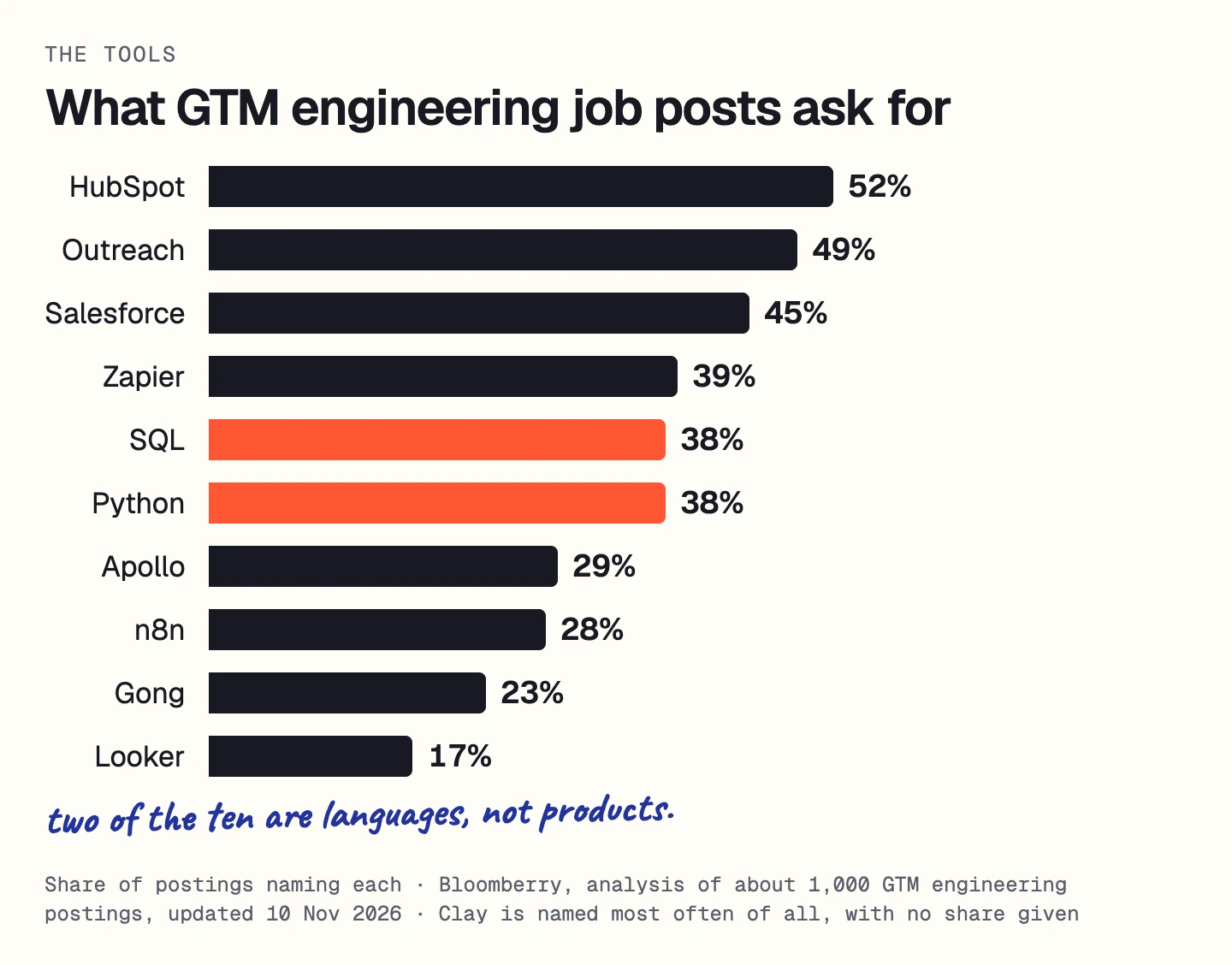
Bloomberry also calls Clay the most popular tool of all, without giving its share. Moody's newer sample has Salesforce in 68% of roles and Clay in 43%.
Most of those are paid products. The open-source side is on GitHub, and the star counts below were read from GitHub on 19 November 2026.
Coding agents. Where more of the building now happens. Which one to pick has the comparison.
- Claude Code, Anthropic's terminal agent (156k stars)
- Codex, OpenAI's terminal agent (136k)
Workflow automation. The glue between tools.
- n8n, workflow automation with AI steps, and the one job posts name (211k)
- Activepieces, automation with connectors for agents (26k)
- Windmill, for workflows written as code (19k)
Web data. Reading sites, at scale and politely.
- Firecrawl, turns web pages into clean text for agents (204k)
- Crawl4AI, a crawler built for language models (88k)
- Crawlee, Apify's scraping library (27k)
- Browser Use, for work that only exists behind a web page (121k)
Records and reporting. Where the data lives and gets counted.
- Twenty, an open-source CRM (61k)
- PostHog, product analytics, for knowing what users did (41k)
- DuckDB, fast analysis on a laptop (43k), and Metabase, dashboards for the team (50k)
- Airbyte, for moving data out of business systems (22k)
Checks. Proof that the prompts and agents do what you think.
- promptfoo, tests for prompts and agents (27k)
- Langfuse, traces and evals for agents in production (38k)
Connectors. How an agent reaches the CRM and the inbox. The MCP reference servers (92k) are the starting point, and MCP servers vs agent skills explains the difference.
A build to read. Vercel published its lead agent as a reference: it takes a contact form, researches the lead, qualifies it, drafts an email and waits for approval in Slack. The repo was archived in June 2026, so read it for the design.
Kenny Damian's advice on choosing is to go deep on a few tools and to pick the ones an agent can drive. His learning order is Claude Code, APIs, SQL, Clay, then n8n. He also says he replaced every tool in his stack within a year. Learn the pattern, not the product. For what is new each week, the repo picks keep track.
How do you build a first GTM system?
Build one play for one kind of customer, end to end, with a person approving every send, and measure replies before you add anything. The example here is outbound, the lane most first jobs start in.
A working order:
- Pick one kind of customer. One industry, one size, one buyer. Not a market.
- Write who is out first. A search for dentists also finds the firms that sell to dentists. Exclusions save more work than filters.
- Start from a signal, not a database. A reason this account matters this week: a funding round, a new sales leader, five open roles.
- Score it, with a reason beside each score. If you cannot read why an account is tier one, the score is noise.
- Enrich only the accounts worth it. Data costs money per row.
- Write one message from the signal. Short, with one ask. The prompt library has patterns to copy.
- Put a person before send. That is human in the loop, and it is what keeps one bad prompt from reaching a thousand inboxes.
- Measure replies, not opens. Positive replies, meetings, bounces and spam complaints.
Check the machine by hand before you scale it. Label 100 examples yourself, run the system on the same 100 and count how often it agrees with you. That number is your evaluation, and it belongs in the write-up.
The one-page play
Before any send, write one page: the customer and who is out, the signal and how old it may be, the offer in one sentence, the limits on sending and who approves, the measure and the result that would make you stop, and who reads the replies. It is the experiment card from the chapter above, for outbound. If you cannot fill in the signal, you are not ready to send.
What rules apply to cold outreach?
Cold outreach is allowed in most places, inside limits set by the mailbox providers, the law and the platforms you send through.
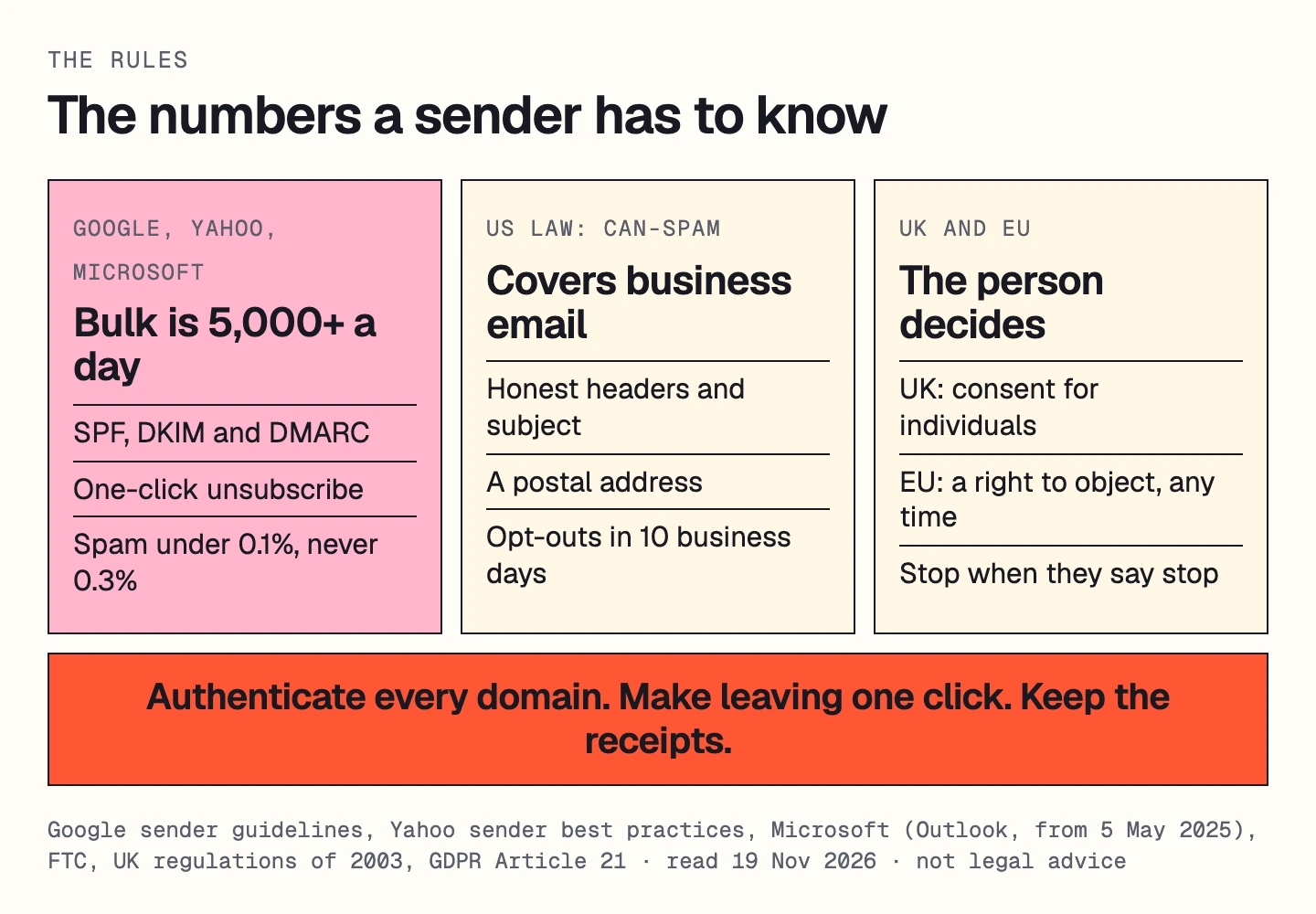
The mailbox providers decide whether your mail arrives:
- Google. Its sender guidelines have applied to everyone who sends to Gmail since 1 February 2024. Above 5,000 messages a day you are a bulk sender: you need SPF, DKIM and DMARC, and marketing mail needs one-click unsubscribe. Keep the spam rate below 0.1% and never reach 0.3%.
- Yahoo. The same shape: authenticated mail, a spam rate below 0.3%, and unsubscribes honoured within two days.
- Microsoft. Since 5 May 2025, Outlook sends mail from domains above 5,000 a day to Junk if it lacks SPF, DKIM and DMARC, and says rejection will follow.
The law decides what you may send:
- United States. The CAN-SPAM Act covers business email, with no exception. The FTC's guide asks for honest headers and subject lines, a postal address, and a clear opt-out honoured within 10 business days. The penalty is up to $53,088 for each email.
- United Kingdom. Regulation 22 of the 2003 privacy regulations requires consent before marketing email to individual subscribers, with a narrow exception for existing customers.
- European Union. The GDPR allows direct marketing to rest on legitimate interest, but Article 21 gives every person the right to object at any time. You must stop when they do, and tell them about that right in the first message. National laws add their own consent rules for email, and they differ.
The platforms decide what you may automate:
- LinkedIn does not permit third-party tools that scrape it or automate activity on it, and says accounts that use them risk being restricted or shut down.
None of this is legal advice. The rules differ by country, so check the ones that cover your recipients before you send.
For the build that means: authenticate every sending domain, make unsubscribing one click, watch spam and bounce rates before reply rates, keep a record of where each contact came from, and stop when someone says stop.
How do AI agents change the job?
Agents move the job from building a workflow step by step to setting a goal, a context and limits, and then checking the work.
- Clay's direction. At Sculpt in October 2026 it showed the Clay Agent, in beta, which plans and runs a play from a goal, and an Inbound SDR Agent, in preview, which qualifies a website visitor and books the meeting.
- Coding agents as the builder. Kenny Damian runs his clients from a terminal: one context file per client, one saved skill per repeatable job. His rule of thumb is that skills hold the knowledge and MCP connections take the actions.
What stays with the person is choosing who to reach, setting the test, and answering for what was sent.
Agents also bring their own failures:
- They read the open web. A page an agent scrapes can carry hidden instructions. That is prompt injection, and a research agent meets it every day.
- They invent. An agent fills a blank with a guess unless "not found" is an allowed answer. See hallucination.
- They send. Anything that emails, posts or writes to the CRM needs an approval step and a log. Six controls before agents act has the list, and why AI agents fail in production has the patterns.
Even the vendor gets it wrong. One talk at Sculpt was titled "Why Clay's First Self-Learning Sales System Failed".
How long an agent can be left alone is a measured thing. The forward deployed guide covers how long AI agents can work alone.
How much do GTM engineers make?
In the United States, the typical advertised base salary for a GTM engineer in 2026 is about $150,000 to $160,000, and it climbs with the amount of software engineering in the role.
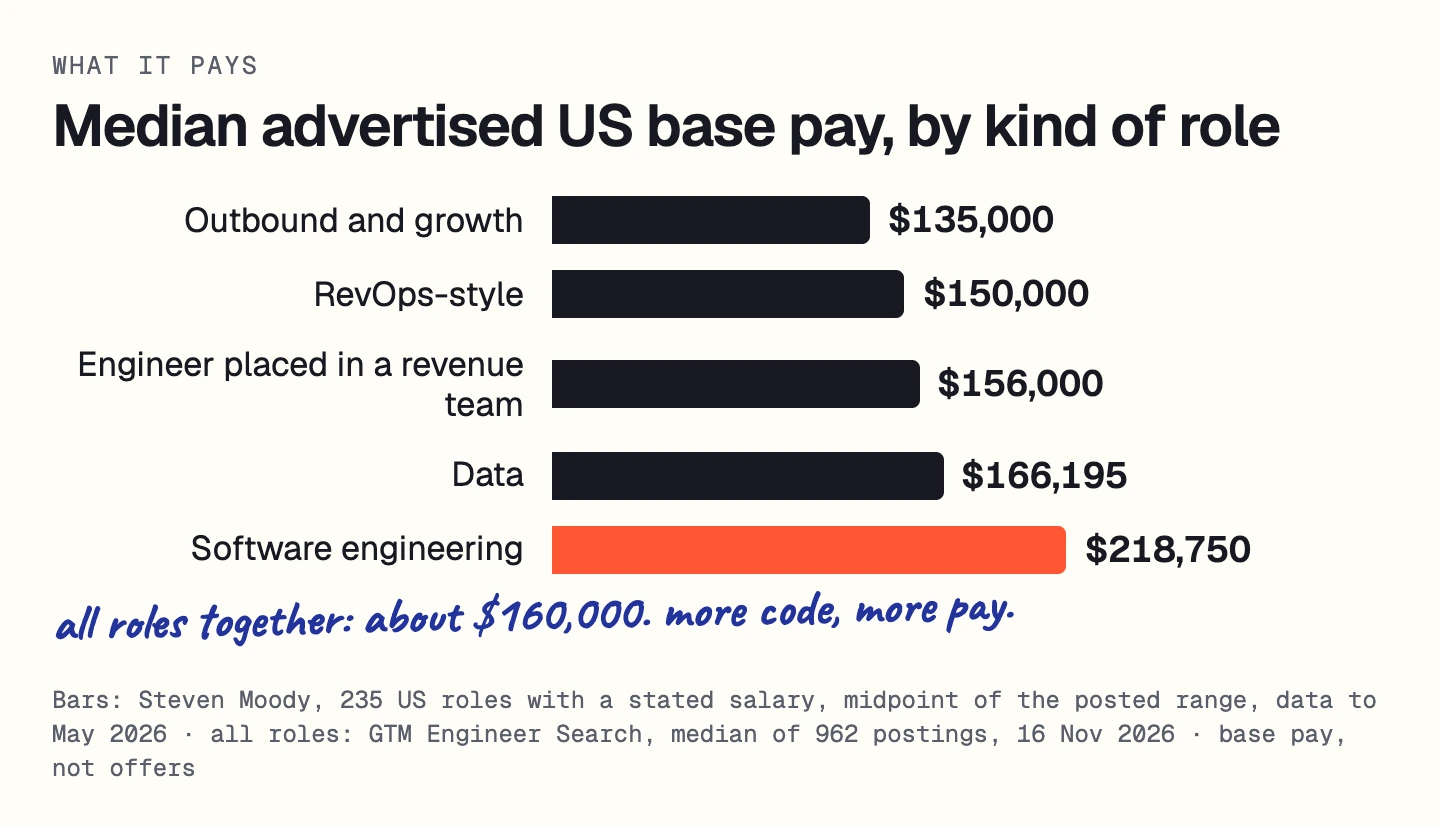
- GTM Engineer Search: a median base of $160,000 across 962 US postings, as of 16 November 2026, with the middle half between $135,000 and $185,000. Its salary page is updated as postings come in.
- Steven Moody: medians by kind of role, from 235 US roles with a stated salary. Outbound and growth roles $135,000, RevOps-style roles $150,000, engineers placed in revenue teams $156,000, data roles about $166,000, and pure software engineering roles about $219,000.
- By level, also Moody: about $151,000 mid-level, $170,000 senior and $201,000 staff.
- Clay: its own open roles in November 2026 run from $140,000 to $220,000 for GTM engineers and $240,000 to $265,000 for a manager, plus equity.
- Anthropic: a role titled AI Engineer, GTM Claudification was listed at $320,000 to $405,000 in The Shortlist in August 2026.
Treat every figure with care:
- They are advertised ranges in the United States, mostly at well-funded software companies, and they are base pay.
- The samples differ, and several come from firms that sell recruiting or tools to this market.
- The spread is the story. The more code in the job, the more it pays. The outbound roles sit $84,000 below the software ones.
How do you become a GTM engineer?
You become one by showing a system you built that produced replies, meetings or revenue. The title matters less than the proof.
The average posting asks for 4.11 years of experience, by Bloomberry's count, and none of the six live postings Kenny Damian read in November 2026 was a junior role. Agencies hire with less: ColdIQ hired Damian in February 2025 with no experience in tech. His advice to anyone with no years behind them is to start at an agency, where the practice comes fast.
Three routes into the job
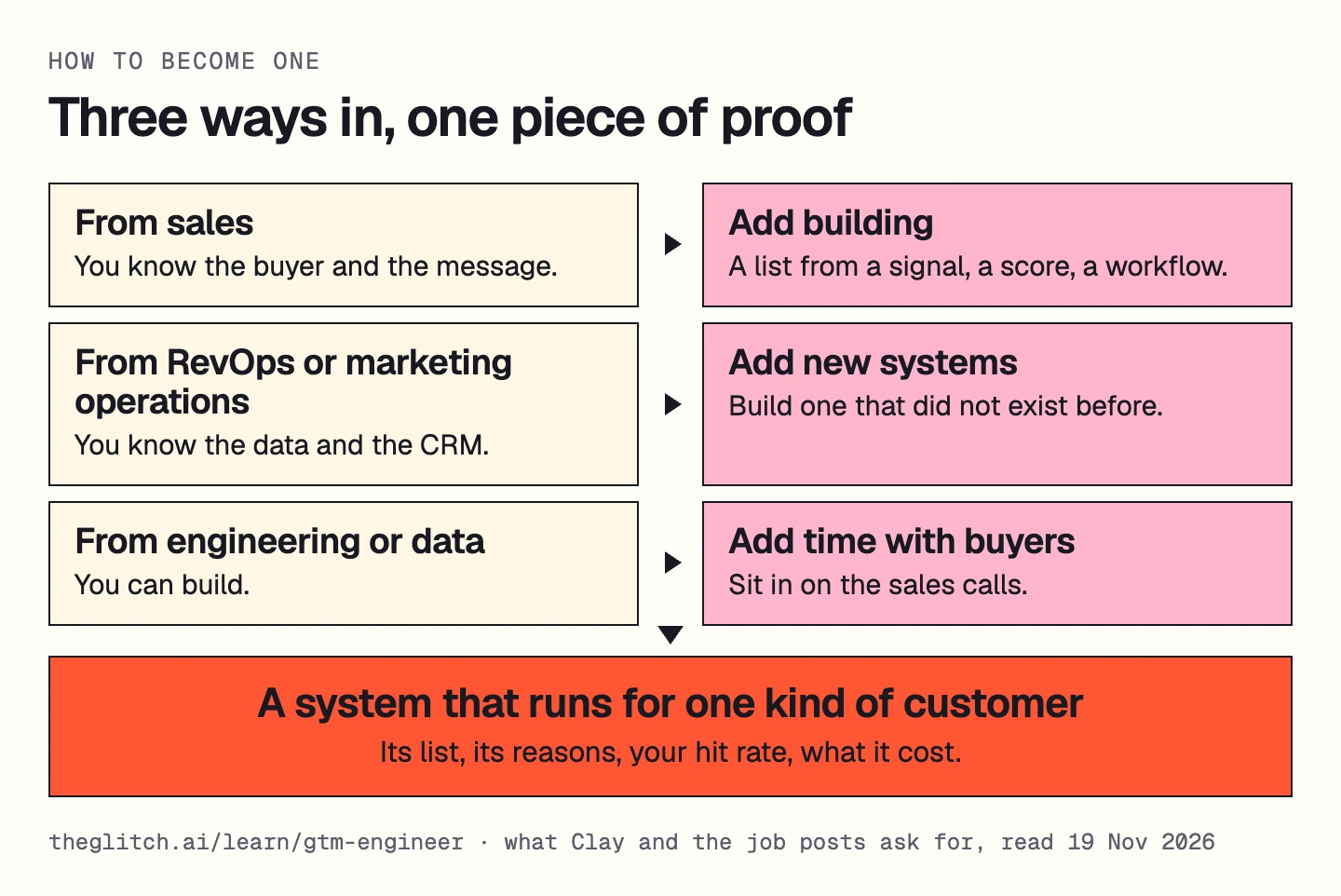
Each route is a T with a part missing:
- From sales. You know the buyer and the message. Learn to build: a list from a signal, a score, a workflow.
- From RevOps or marketing operations. You know the data and the CRM. Move from keeping systems running to building one that did not exist.
- From engineering or data. You can build. Learn who buys and why, by sitting in on sales calls.
- From growth. You have the funnel and the habit of testing. Add the building.
A 90-day plan
- Build one list from a public signal, for one niche. Publish it with what it cost.
- Add scoring with a reason beside each score. Label 100 by hand and publish how often the system agreed.
- Run one small campaign for a real business, inside the sending rules above. A friend's business counts.
- Write the play up on one page: the signal, the message, the numbers and what failed. This site keeps its own build log in the notes.
- Do it again for a different kind of customer. Two is a pattern.
In the portfolio, show the reason each account is on the list, your hit rate on a sample you labelled yourself, and what it cost to run.
Courses and training
- Clay University. Its courses run from Clay 101 to automated outbound, automated inbound, signals and CRM enrichment, with certifications in inbound, outbound and ads.
- Clay's scholarship. The $1 million fund announced in September 2026 pays for GTM engineering programmes, with priority for career changers and people early in their careers.
- Paid cohorts and schools. They multiplied in 2026. Check who teaches, and whether you finish with a running system or only a certificate.
None of them replaces a system you can point to.
What is the GTM engineer interview like?
Expect to build something and defend it. The interview tests judgment as much as tools.
Clay describes its own loop: about five interviews and a take-home, done in two weeks or less. A 30-minute screen asks for the most complex GTM system you have built. A 45-minute review goes through your portfolio, including a workflow that broke. A case study arrives five to seven days ahead: rebuilding inbound routing, building renewal signals for reps or auditing an agent. Clay says it grades the take-home on how clearly you see the whole system.
Agencies test the same thing faster. Damian describes his co-founder's opening: he hands the candidate a customer profile and listens to the first question. Asking which list to build is the wrong start. The right one asks which signal shows an account is ready to buy.
Practise that out loud:
- Take a product you know.
- Say who buys it, and what changes just before they do.
- Say how you would spot that change in public data.
- Say what you would send, and what you would count.
Is GTM engineering a good career?
It is a good career if you like building and want to sit close to revenue. It is a poor one if you want stable tools or deep engineering work.
Why become one
- The pay. A typical US base of about $150,000 to $160,000, and 24.7% more than RevOps staff in the Pave data Clay published.
- The demand. Headcount doubled in a year, by Sumble's count, and about 100 listings go live each month, by Clay's.
- One person, a whole system. You build what used to wait on a pod, and the result shows: meetings, pipeline, revenue.
- It outlasts the title. Range across the funnel and one deep craft keep their value when the name changes.
- The way on. Revenue leadership, founding a company, or forward deployed work.
Why not
The downsides, from people who looked closely:
- The title is stretched. At small companies it is often outbound sales with new tools.
- It may be a rename. Simon Daniels calls it a red flag when a company hires GTM engineers and leaves its RevOps team as it was.
- The search peak has passed. Interest in the title fell after June 2026. Titles come and go faster than the work does.
- The ceiling is unclear. Everett Berry does not expect 200-person GTM engineering departments or vice-president titles.
- You answer for what gets sent. A spam complaint, a burned domain or a legal letter lands on the person who built the system.
Questions to ask before you accept an offer:
- What will I build in the first 90 days, and who will use it?
- Who owns the data and the CRM?
- How is my work measured?
- How much of the week is sending campaigns?
- Who do I report to: sales, marketing, operations or engineering?
Should you hire a GTM engineer?
Hire one when you have a way of winning customers that works by hand and now needs to run as a system. Before that, there is nothing to systemize.
Clay's hiring guide gives no funding stage, and warns against using one as the trigger. It names two conditions: product-market fit, and a revenue motion that needs to be turned into a system. An early company needs someone who tries plays quickly. A company with a repeatable motion needs someone who builds and maintains.
Decide which of the five systems you need first. That tells you which stem to hire.
Your options:
- Grow one inside. The RevOps person or sales rep who already builds things on the side. Give them one play and a deadline.
- Use an agency. A faster start. Make sure the systems, the domains and the data stay yours.
- Hire one. Expect $135,000 to $185,000 in base pay for most US roles, and a thin market.
- Bring in an independent. One person for a fixed scope, with the handover written into the contract.
Do not hire one to send more email. More of the same is what the mailbox rules were written to stop.
Whoever does the work, ask them these before they start:
- Which one play are we starting with, and who owns it?
- Which number will move, and how will we count it?
- What may the system send without a person?
- What do we run ourselves on the day you leave?
If you want a second pair of hands building one, that is the work I do.
Who should you follow and watch?
Follow the people who build these systems or count the jobs first-hand. These are the ones this guide leans on.
Read:
- Kenny Damian, How to Become a GTM Engineer: nine steps from someone hired with no tech experience. The most practical piece on outbound.
- Clay, the guide to GTM engineering and how it hires: the company that named the job. Read it as a vendor's view.
- Kyle Poyar, Growth Unhinged: who is hiring across go-to-market, from Sumble's job data.
- Henley Wing Chiu, Bloomberry: what the job posts ask for.
- Steven Moody's salary benchmark: pay by kind of role, checked by hand.
- Tomasz Tunguz on Vercel: ten reps down to one and when inbound sells itself.
- Barb Mosher Zinck, Diginomica: the sceptic's case.
Watch and listen:
- Lenny's Podcast with Jeanne DeWitt Grosser: Vercel's operating chief on what go-to-market looks like in 2026. The full post is for paying subscribers.
- Andy Mowat's notes on Everett Berry: a podcast interview with Clay's head of GTM engineering, written up.
- The Sculpt 2026 showcase: what Clay is building next.
Keep up: the radar checks the week's AI news, and Latest lists everything new on this site.
What should you read next?
Read the part of this site that matches the gap you just found. Every other guide here is listed below, grouped by the part of the job it teaches.
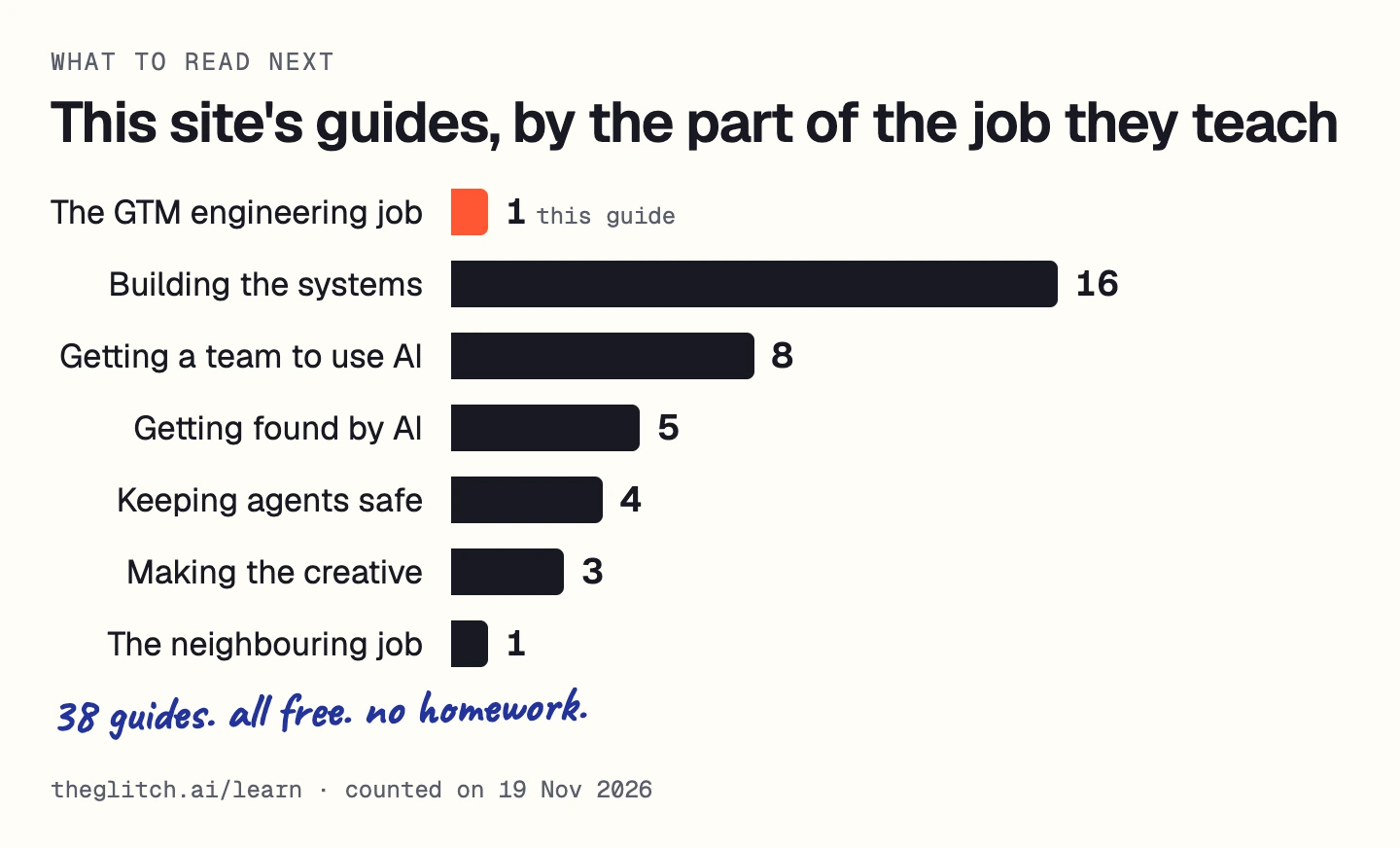
Building the systems
- Agents for growth teams, AI agents explained and build your first agent
- Claude Code best practices, Claude Code vs Codex vs Gemini CLI and debugging with AI
- MCP servers vs agent skills and the best MCP servers
- Prompting and context engineering
- Building apps without code and the AI app builders
- The open-source agents and local model tools
- The voice agent platforms, for calls, and the AI note takers, for getting call notes into the CRM
Getting found by AI
- Getting cited by AI search, the AI visibility audit and writing content AI will quote
- What WebMCP is and how to add it to a site
Keeping agents safe
- Why AI agents fail in production and six controls before agents act
- Prompt injection explained and the AI browsers
Getting a team to use AI
- Where AI pays off, rolling it out and measuring the return
- Which tools to pick and 27 AI terms to know
- How to get good at AI fast, a first-week plan and stop learning, start using
Making the creative
The neighbouring job
- What is a forward deployed engineer? The engineer who builds inside the customer's business.
The shelves
The AI glossary, the prompt library, the prompt workbench, the radar, repo picks, bookmarks, the notes and Latest.
What's happening now
- A nine-step guide went wide. Kenny Damian, co-founder of the agency Frontal, published a nine-step guide to getting hired as a GTM engineer. It passed 90,000 views in three days. Kenny Damian on X
- Clay explained how it hires. Clay set out its own loop: about five interviews and a take-home, decided in two weeks or less. Its open GTM engineer roles listed $140,000 to $220,000 plus equity. Clay
- Small-company roles are mostly outbound. Bitscale read 1,000 GTM engineer job posts. At companies under 50 people nearly 90% were outbound outreach. At companies over 1,000 people the share was under 40%. Bitscale
- Clay showed its agents at Sculpt. At its conference in San Francisco, Clay showed the Clay Agent, in beta, which plans and runs plays from a goal, a visual Workflows builder, and an Inbound SDR Agent in preview. Clay
- Clay raised $115 million. Clay announced a $115 million Series D led by Wellington Management at a $7.1 billion valuation, and a $1 million scholarship fund to train GTM engineers. The Next Web
- Anthropic listed a GTM role above $320,000. The Shortlist's weekly roundup listed an Anthropic role titled AI Engineer, GTM Claudification at $320,000 to $405,000: what the engineering end of the job can pay. The Shortlist
- SDR postings fell as GTM engineers doubled. Sumble's job data, reported by Kyle Poyar, showed new SDR postings down 21% in a year at US digital-native companies, while GTM engineering headcount doubled to more than 400 people. Growth Unhinged
- Clay's order of work. Everett Berry, interviewed as Clay's head of GTM engineering, gave the order he works in: fix the data first, then automate broken processes, then build new plays. GTM Council
Fresh from This week in AI
| Main goal | Builds new systems | Talks to buyers | |
|---|---|---|---|
| GTM engineer | Build the systems the revenue team runs on | Yes, that is the job | Rarely |
| RevOps | Keep the existing systems working | Sometimes | No |
| Sales development rep | Book meetings from a list | No | All day |
| Forward deployed engineer | Make the product work inside one customer | Yes, in the customer's systems | Yes, one customer |
Boss fight
A team buys a data tool and a sequencer and triples its email volume. What is still missing?
- More sending domains
- A reason each account is on the list
- A bigger list
Answer: A reason each account is on the list. Volume without a reason is spam. The job is deciding who is worth reaching, then building the system that reaches them.
Google treats you as a bulk sender above 5,000 messages a day to Gmail. Which spam rate must you never reach?
- 3%
- 1%
- 0.3%
Answer: 0.3%. Google says to keep the rate below 0.1% and never reach 0.3%. Above that, your mail stops arriving.
What separates a GTM engineer from RevOps?
- A higher salary
- Building new systems, not keeping existing ones running
- Using Clay
Answer: Building new systems, not keeping existing ones running. RevOps runs what exists. A GTM engineer builds what is missing. Many sit in the same team.
Questions people ask
What does GTM engineer stand for?
GTM stands for go-to-market, so a GTM engineer is a go-to-market engineer: the person who builds and automates the systems a revenue team uses to find, research and reach buyers. Clay, which created the title in 2023, shortens it to GTME. Some companies call the same job a GTM systems engineer, a revenue engineer or a growth engineer.
What is GTM engineering?
GTM engineering is the practice of building automated revenue systems with AI, data and workflow automation, instead of running sales and marketing by hand. The unit of work is a system, not a task: a scoring model, a lead router, a research agent. The definition comes from Clay, the company that named the job.
How much does a GTM engineer earn?
In the United States the typical advertised base salary in 2026 is about $150,000 to $160,000. GTM Engineer Search found a median of $160,000 across 962 postings in November 2026. Steven Moody’s benchmark shows the spread: about $135,000 for outbound and growth roles and about $219,000 for roles that are pure software engineering. These are advertised base figures, not offers.
Is a GTM engineer the same as RevOps?
No, though the two overlap and many GTM engineers sit inside RevOps teams. RevOps keeps the existing revenue systems running: the CRM, the reports and the process. A GTM engineer builds new systems on top of them. In Pave data published by Clay, GTM engineers earn 24.7% more than RevOps staff. Some observers argue the job is operations work with a new name.
Do you need to code to be a GTM engineer?
Not always, but it pays to. Clay’s guide says coding is not strictly required and that a willingness to learn tools by tinkering matters most. Job posts ask for more: SQL and Python each appear in 38% of postings in Bloomberry’s sample, and Clay itself asks for one programming language plus APIs and webhooks. The best-paid roles are the most technical.
What tools do GTM engineers use?
A CRM such as HubSpot or Salesforce, a data tool such as Clay or Apollo, a sequencer for sending, an automation tool such as n8n or Zapier, and more and more a coding agent such as Claude Code. In Bloomberry’s analysis of job posts, HubSpot is named in 52%, Outreach in 49%, Salesforce in 45% and Zapier in 39%.
How do I become a GTM engineer with no experience?
Build a system and show it. Make one list from a public signal, score it, run one small campaign for a real business inside the sending rules, and publish the numbers and the cost. Most job posts ask for about four years of experience, so agencies are the usual way in: Kenny Damian was hired by one in February 2025 with no experience in tech.
What skills does a GTM engineer need?
They need to be T-shaped. The bar is working knowledge of five things: the funnel, the data, building with APIs and a coding agent, the message, and running tests. The stem is one craft known deeply, such as outbound, paid creative, search, free tools or product growth. Job posts ask for SQL and Python in 38% of postings in Bloomberry’s sample, and Clay asks for one programming language plus APIs and webhooks.
Will AI agents replace GTM engineers?
Agents are replacing steps, not the job. At Vercel, one GTM engineer built an agent that took over most inbound sales development, and nine of ten reps moved to outbound. Somebody still decides who is worth reaching, sets the test and answers for what gets sent. That part is the GTM engineer’s, and it is growing.
When should a startup hire a GTM engineer?
When it has product-market fit and a way of winning customers that works by hand and now needs to run as a system. Clay’s hiring guide gives no funding stage and warns against using one as the trigger. Before there is a repeatable motion there is nothing to systemize, and an agency or a part-time builder is the cheaper test.
Key terms
Agent · Workflow · Automation · API · Human in the loop · Evaluation · Hallucination · Model Context Protocol · Agent skill · Coding agent
Try it here
Prompt library · Prompt workbench · AI glossary
Sources
- Clay: How to hire a go-to-market engineer for the agentic GTM era
- Clay: The Complete Guide to GTM Engineering (2026)
- Genesys Growth: How GTM engineering came to be
- The Next Web: Clay raises $115m at a $7.1bn valuation
- Clay: Sculpt 2026 showcase
- Diginomica: What if GTM Engineers are simply Marketing Operations people in disguise?
- Bloomberry: I analyzed 1000 GTM Engineering jobs
- Growth Unhinged: Who's actually hiring in GTM right now?
- Google Trends: GTM engineer and forward deployed engineer, 2021 to 2026
- Tomasz Tunguz: Vercel's AI Sales Agent, 10 SDRs Down to 1 in Six Weeks
- SaaStr: Vercel Took a 10-Person SDR Team Down to 1
- Tomasz Tunguz: When Inbound Sells Itself
- GTM Council: Everett Berry, Head of GTM Eng at Clay
- Kenny Damian: How to Become a GTM Engineer, The Complete Guide
- Bitscale: GTM Engineer Jobs 2026, What 1,000 Job Posts Ask For
- Steven Moody: GTM Engineer Salary 2026
- GTM Engineer Search: GTM Engineer Salary
- The Shortlist: Edition 009, GTM Engineer Jobs
- Vercel Labs: lead-agent (GitHub)
- Google: Email sender guidelines
- Yahoo: Sender best practices
- Microsoft: Outlook's new requirements for high-volume senders
- FTC: CAN-SPAM Act, a compliance guide for business
- UK legislation: Privacy and Electronic Communications Regulations 2003, regulation 22
- GDPR: Article 21, right to object
- LinkedIn: Prohibited software and extensions
- Clay University
- Lenny's Podcast: What world-class GTM looks like in 2026, with Jeanne DeWitt Grosser
- Sean Ellis: Find a Growth Hacker for Your Startup (2010)
- Andrew Chen: Growth Hacker is the new VP Marketing (2012)
- TechCrunch: Real Engines Of Growth Have Nothing To Do With Growth Hacking (2014)
- Tech.eu: Europe's first growth hacking academy, kicking off in Amsterdam (2015)
- Chief Executive: IDEO CEO Tim Brown on T-shaped people (January 2010)
- Rand Fishkin: The T-Shaped Web Marketer (September 2013)
- Intercom: Sean Ellis on charting a path toward sustainable growth (June 2018)
- Dave McClure: Startup Metrics for Pirates
- Ward van Gasteren: The G.R.O.W.S. process by Growth Tribe
- HubSpot: Website Grader selected as a 2007 MITX Awards finalist
- LinkedIn Help: Get started with Matched Audiences
- Google Ads Help: About Customer Match
- Fortune: the prompt engineer title is already obsolete (May 2025)
- GitHub: glitch-rabin/swarma