How AI agents fail in production.
Made-up fields, cost spirals, silent failures, bad inputs, drift and runaway actions: how agents break, how to spot each and what to build first.
By Rabin Nuchtabek · Updated 2026-10-29 · 3 min read · For Builders, Leaders
Part of What is a forward deployed engineer? The ultimate guide to becoming one in 2027
Every agent fails. The question is whether you find out from your logs or from a customer. These are the six failure modes that show up again and again, roughly in order of how often they hurt.
1. Confident wrong answers
The agent fills a field the source didn't contain, cites a page that doesn't say that, or summarizes a ticket with a detail it made up (hallucination). It looks exactly like a right answer.
- Prevent: ground outputs in retrieved sources (grounding), ask for a quote or link for every claim, and use structured output that allows "unknown", so the model isn't forced to guess.
- Detect: spot-check a sample every week, and automatically check that quoted text really appears in the source.
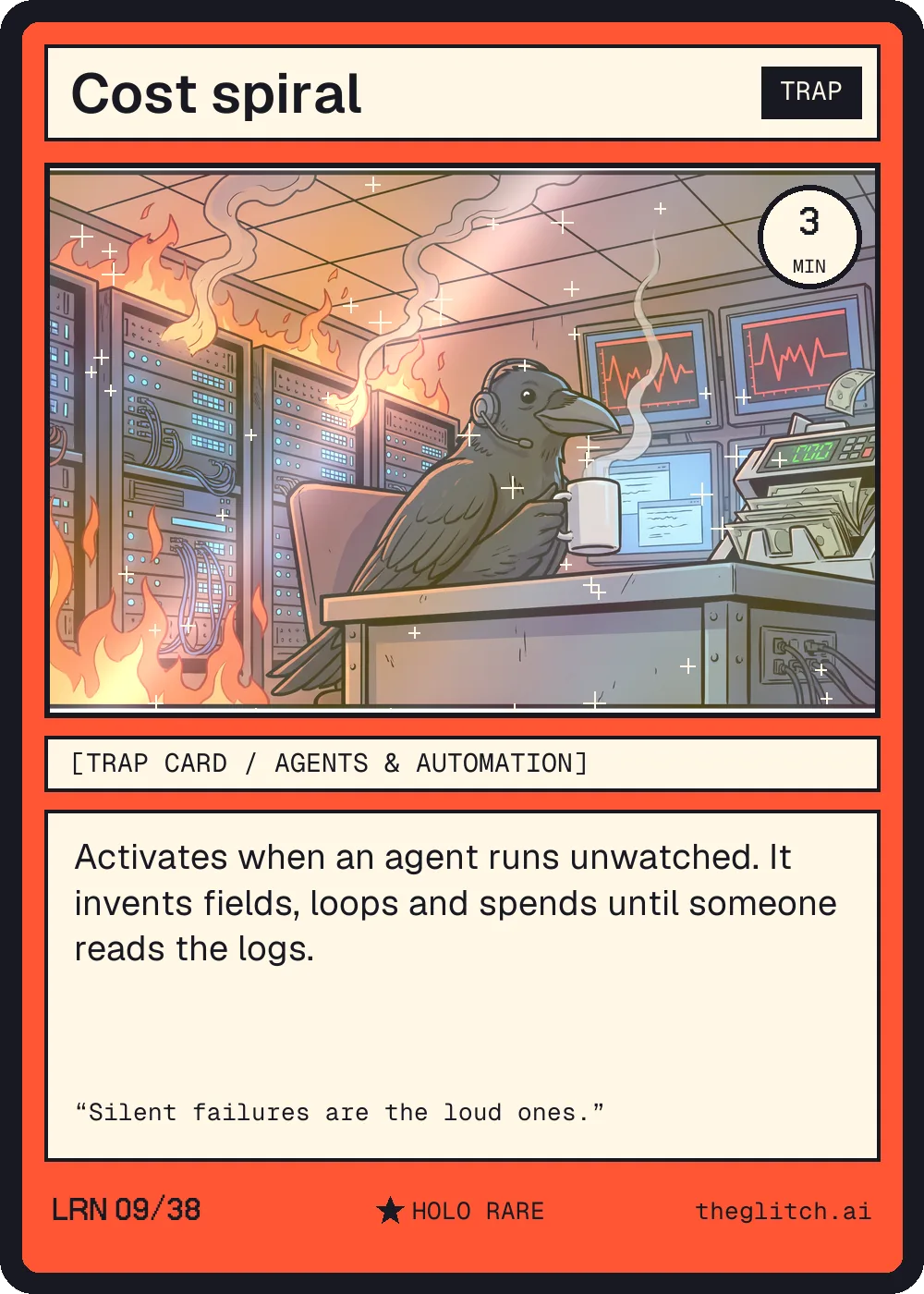
2. Cost spirals
A loop that never ends, a retry storm, a huge document re-read at every step. Agents are token-hungry by design, and a bug can multiply the bill overnight.
- Prevent: hard caps on steps per run, tokens per run and spend per day; rate limits on tools; prompt caching for the parts that repeat.
- Detect: a daily cost alert per agent, set at a level you'd actually notice.
3. Silent failures
The scheduled run didn't happen. An API key expired. A scraper got blocked and returned an empty page, which the model happily summarized as "no changes". Nothing errored. Everything looked fine.
- Prevent: treat empty or tiny inputs as errors, and check outputs against simple rules: counts, required fields, date ranges.
- Detect: heartbeat alerts. If the agent hasn't produced output when it should have, someone gets a message.
4. Bad inputs
Real data is messier than test data: duplicate records, a CSV with a new column, an email in another language, a PDF that's really a scan. Agents degrade quietly on inputs nobody planned for.
- Prevent: validate inputs at the door, and route anything unusual to a human queue.
- Detect: track the share of runs that land in that queue. A sudden rise means the inputs changed.
5. Drift
Same prompt, different result. The provider updated the model, a tool changed its output format, or someone "improved" the prompt. Quality slides and nobody notices for weeks.
- Prevent: pin model versions where you can, keep prompts in version control and rerun a fixed set of real test cases on every change (prompt regression testing).
- Detect: score that test set weekly and compare with the last good version.
6. Doing the wrong thing, confidently
The agent follows an instruction it shouldn't: one hidden in a web page or email it read (prompt injection), or a vague goal it read creatively. With write access, this is where real damage happens: deleted records, wrong emails, unwanted purchases.
- Prevent: least privilege, human approval for anything irreversible, and no single agent that can read untrusted content, reach private data and send data out. More in Lock down your agents before they act.
- Detect: log every action with its reason, and review high-impact actions daily at first.
The minimum to build
If you only do four things:
- Log every run: inputs, steps, outputs and cost.
- Cap steps and spend.
- Alert on failure and on silence.
- Keep twenty real test cases and rerun them on every change.
That covers most of the incidents that sink agent projects. Gartner expects more than 40% of agentic AI projects to be canceled by the end of 2027, mostly over rising costs and unclear value. Most of that is avoidable with boring engineering. To build the first one the boring way, see Build your first agent, the boring way.
Questions people ask
What is a silent failure in an AI agent?
A silent failure is when something goes wrong but nothing errors and everything looks fine. Examples include a scheduled run that never happened, an expired API key, or a blocked scraper returning an empty page that the model summarizes as "no changes". Prevent it by treating empty or tiny inputs as errors, and detect it with heartbeat alerts that message someone when expected output doesn't appear.
How do I stop my AI agent from running up huge costs?
Set hard caps on steps per run, tokens per run and spend per day. Add rate limits on tools and use prompt caching for the parts that repeat. Loops that never end, retry storms and re-reading huge documents at every step can multiply the bill overnight, so add a daily cost alert per agent at a level you would actually notice.
Is pinning model versions worth it to prevent agent drift?
Yes, where you can, because drift makes quality slide unnoticed for weeks. Drift happens when the provider updates the model, a tool changes its output format, or someone edits the prompt. Pair pinning with prompts in version control and a fixed set of real test cases rerun on every change, then score that set weekly against the last good version.
What is the biggest risk of giving an AI agent write access?
The biggest risk is the agent doing the wrong thing confidently, such as following an instruction hidden in a web page or email, or reading a vague goal creatively. With write access this causes deleted records, wrong emails or unwanted purchases. Use least privilege, require human approval for anything irreversible, and log every action with its reason.
How should I prepare for AI agent project cancellations in 2027?
Build the boring basics now, since Gartner expects more than 40% of agentic AI projects to be canceled by the end of 2027, mostly over rising costs and unclear value. Log every run with inputs, steps, outputs and cost. Cap steps and spend. Alert on failure and on silence. Keep twenty real test cases and rerun them on every change.
Key terms
Hallucination · Grounding · Structured output · Rate limit · Prompt caching · Prompt regression testing · Prompt injection · Least privilege