What is a forward deployed engineer? The ultimate guide to becoming one in 2027
A forward deployed engineer builds AI inside a customer's business. What the job is, who hires, what it pays, how to scope, test and ship, and how to become one.
By Rabin Nuchtabek · Updated 2026-11-20 · 25 min read · For Must know, Builders, Marketers, Leaders
A forward deployed engineer (FDE) is a software engineer who works inside a customer's business, builds AI systems in the customer's own tools and data until they run in production, and brings what they learned back to the company that makes the product. Palantir invented the job. The AI labs made it one of the fastest-growing engineering jobs of 2026.
This guide covers the whole job: what it is, where it came from, what the work looks like, what it pays, how to scope, test and ship a deployment, how to become one, and whether your company needs one. Every fact was checked at its source on 17 November 2026. It is long on purpose, so use the menu to jump to the part you need.
What is a forward deployed engineer?
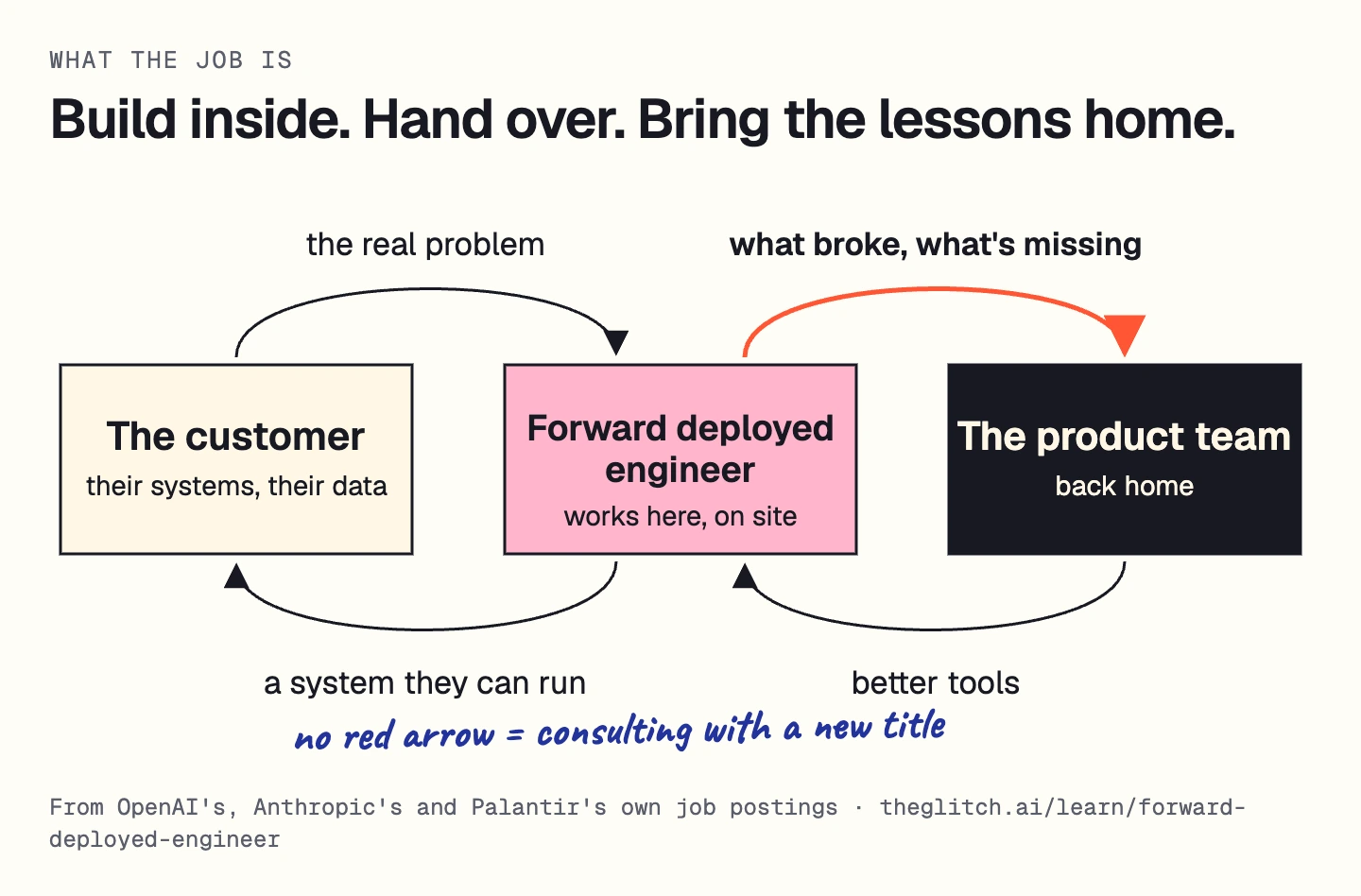
A forward deployed engineer is an engineer placed with the customer instead of with the product. They sit with the customer's team, learn how the work is really done, and build software that runs in that company's systems, with that company's data.
OpenAI's job posting gives the scope in one line: its forward deployed engineers own discovery, technical scoping, system design, build and production rollout. Anthropic's posting adds the ending: you build inside the customer's systems and leave them with something they can run without you.
Three things separate the job from ordinary software work:
- One customer, many problems. Palantir's framing, as The Pragmatic Engineer reports it, is one customer and many capabilities, where a product engineer has one capability and many customers.
- Production, not demos. The code runs in the customer's real environment, behind their security reviews and next to their old systems.
- A loop back home. What the engineer learns in the field changes what the company builds next. KDnuggets calls this the defining test. Without that loop, the job is consulting with a new title.
The same job goes by other names: forward deployed software engineer (Palantir's title), applied AI engineer, agent engineer and deployment engineer. Anthropic's training programme calls its graduates Frontier Deployed Engineers. The letters stay FDE.
Where did the forward deployed engineer come from?
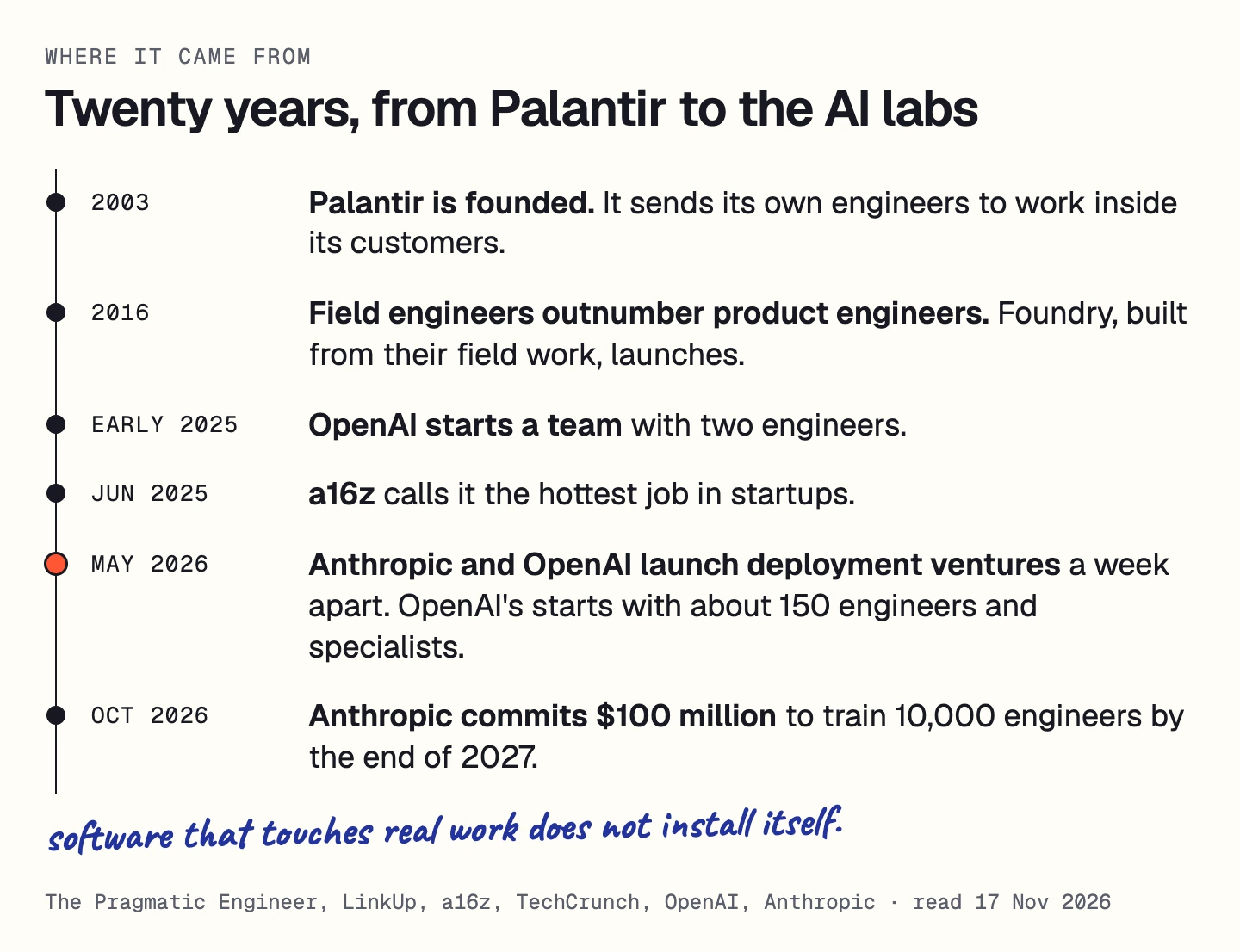
The role came from Palantir, which sent its own engineers to work inside customers that could not explain what they needed or share their data freely. Sources differ on the date: LinkUp places it in the mid-2000s, and The Pragmatic Engineer in the early 2010s, when the role was called Delta.
- Engineers went on site. Nabeel Qureshi, who joined Palantir as a forward deployed engineer in 2015, writes that they worked from the customer's offices three to four days a week.
- Field work became the product. The engineers did the same dull jobs by hand at every customer. Product engineers back home turned those jobs into tools. Those tools became Foundry, which Qureshi says was bringing in more than half of Palantir's revenue by 2024.
- They outnumbered the product engineers. Around 2016, Palantir had more forward deployed engineers than ordinary software engineers.
Then the AI companies copied it:
- Early 2025: OpenAI started a forward deployed engineering team with two engineers. It had more than ten by August 2025.
- June 2025: Andreessen Horowitz called it the hottest job in startups.
- May 2026: Anthropic announced a services venture with Blackstone, Hellman & Friedman and Goldman Sachs. A week later OpenAI launched the OpenAI Deployment Company with more than $4 billion of investment and agreed to buy Tomoro, a firm with about 150 forward deployed engineers and deployment specialists.
- September 2026: Fortune counted open forward deployed roles at Microsoft, Meta, Google, OpenAI and Anthropic, and about four dozen at Palantir.
- October 2026: Anthropic committed $100 million to train 10,000 engineers for this work by the end of 2027.
The pattern is the one Palantir found twenty years ago. Software that touches how a company really runs does not install itself. Somebody has to go there.
Why are companies hiring forward deployed engineers?
Companies are hiring them because the models got good faster than businesses could use them. The gap is no longer the technology. It is fitting the technology into one company's data, systems and habits, and that takes a person on the inside.
Colin Jarvis, who founded OpenAI's team, calls it the deployment gap: the distance between what models look able to do and what people can rely on at work. OpenAI said the same when it launched its deployment company: more than a million businesses had adopted its products, and the next stage would be decided by how well they deploy them. Anthropic's academy announcement calls the people who can make AI work inside a real business the hardest ones to hire.
The hiring numbers, each from a different counter:
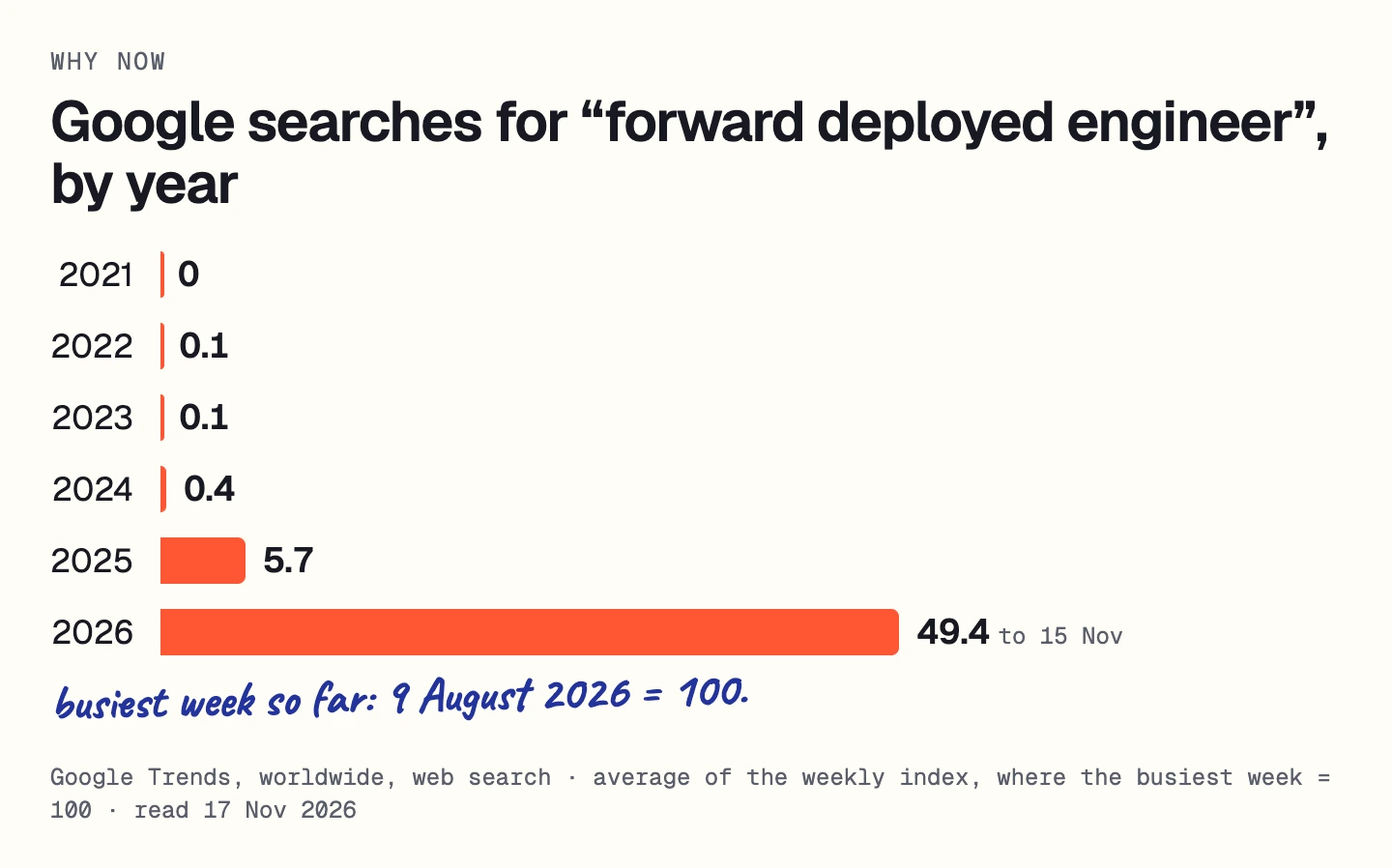
- LinkUp: listings naming forward deployed engineers or architects sat near 300 through 2022 and 2023, then passed 5,000 by early 2026.
- Indeed: postings in April 2026 were up more than 729% on April 2025, as LeadDev reported.
- Lightcast: postings from January to August 2026 were more than ten times the same months of 2025, as Fortune reported, while tech postings overall grew 13%.
Two cautions:
- The counts do not match. Each firm defines the role differently, so do not add them up or compare them.
- The market is still small. One tracker cited by KDnuggets found 224 open roles across 39 companies on 30 May 2026. A fast-growing small number is still a small number.
Why companies pay for it
Hands-on deployment is expensive, and software investors used to punish that. Andreessen Horowitz argues the opposite for AI: the companies that did the heavy fitting-in during the last big shift became the hardest to replace.
- ServiceNow and Workday went public with gross margins of about 63% and 54%, well under the 80% expected of software. By 2024 they were at 79% and 75%.
- Palantir is the proof inside this story. Qureshi notes its gross margin was 80% in 2023, against 32% for Accenture, because years of field work had turned into a product.
The pay follows the shortage. Nick Saraev makes the argument in a video on careers that stay paid: pay moves to whatever is scarce, and once building gets cheap, the scarce thing is the person who can get inside a business and put agents to work there.
What does a forward deployed engineer do?
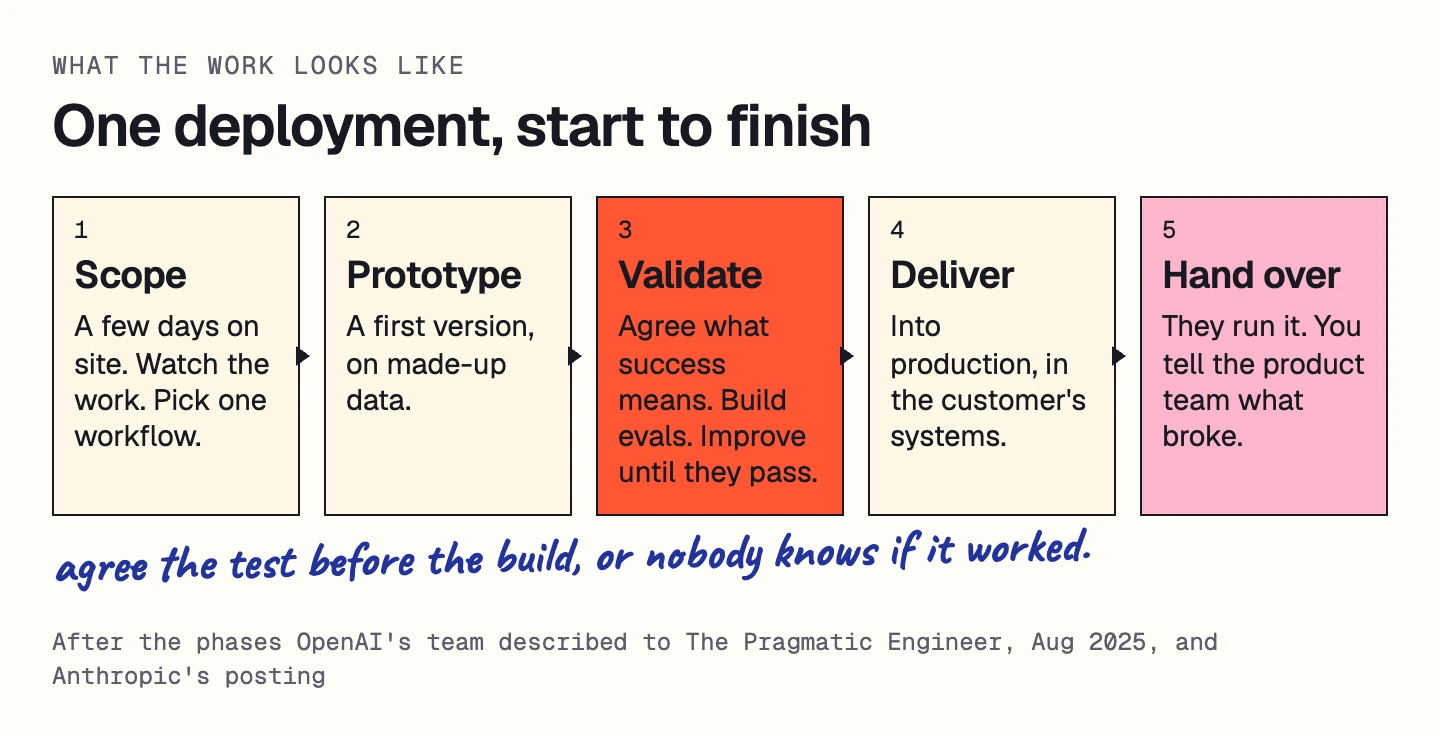
Day to day, a forward deployed engineer scopes a problem with the customer, builds a working version fast, proves it against agreed tests, ships it into production and hands it over. Then they tell the product team what broke.
OpenAI's team described its projects to The Pragmatic Engineer in three phases:
- Scoping. A couple of days on site. Map how the work is done, find where the value is, build a first prototype on made-up data.
- Validation. Agree what success means, build evals to measure it, improve until the numbers hold, report against the goals.
- Delivery. On site a few days a week, building and showing progress until it runs in production.
Three of OpenAI's projects, from its own account:
- A chip maker. About 15 engineers, more than ten use cases, all in production within three to six months. Writing directed tests took about 48% less time.
- A phone company. At the start, the voice model scored about 60% on the customer's evals. Six months of work with OpenAI's researchers took it past 90%, and the improved model now serves other customers too.
- A farm equipment maker. John Deere uses the models to give farmers personal advice on a weed-spraying system. The Pragmatic Engineer adds that the team's head and an engineer went to Iowa to work with the farmers.
What fills the week:
- Talking to the people who do the work. Palantir's posting lists conversations with customer executives next to architecture and coding. Qureshi says success depended on earning the trust of the customer's people and learning their language fast.
- Data plumbing. Getting access to data, cleaning it and putting it where the system can use it. Qureshi calls this the core of the work, and the part outsiders underrate.
- Building. Agents, integrations, small apps and evals. Anthropic's posting names production applications and agent components.
- Travel. Palantir asks for 25 to 50%, Anthropic about 25%, OpenAI up to 50%.
The data part deserves a second look, because it is where projects stall. Qureshi breaks it into three steps: get access to the data, which means negotiating with the people who own it; clean it; and put it somewhere everyone can use it. Most of the base of Palantir's platform, he writes, is tooling for exactly that.
How much of it is coding depends on the employer. Gergely Orosz of The Pragmatic Engineer read one Google posting as roughly a quarter coding, half integration work and a quarter meetings. That is his estimate, and a useful one to hold against any job advert.
The independent agent operator
There is a second version of the job, outside the big vendors. Nick Saraev describes the independent operator who goes into a smaller business and does the same loop without a product behind them:
- Have the owners and department heads walk through every process.
- Sort the tasks: ones an agent can finish alone, and ones that need a person working with an agent.
- Build the first group. Train people for the second.
In companies under about a hundred people, he says, the work usually starts with growth: reach, acquisition, conversion and expansion. His other point is worth keeping. The building is no longer the hard part. Getting into the business, and getting people to explain how they really work, is.
Forward deployed engineer vs solutions engineer vs consultant
A solutions engineer helps win the deal, a consultant delivers a project and leaves, and a forward deployed engineer stays until the product works in production.
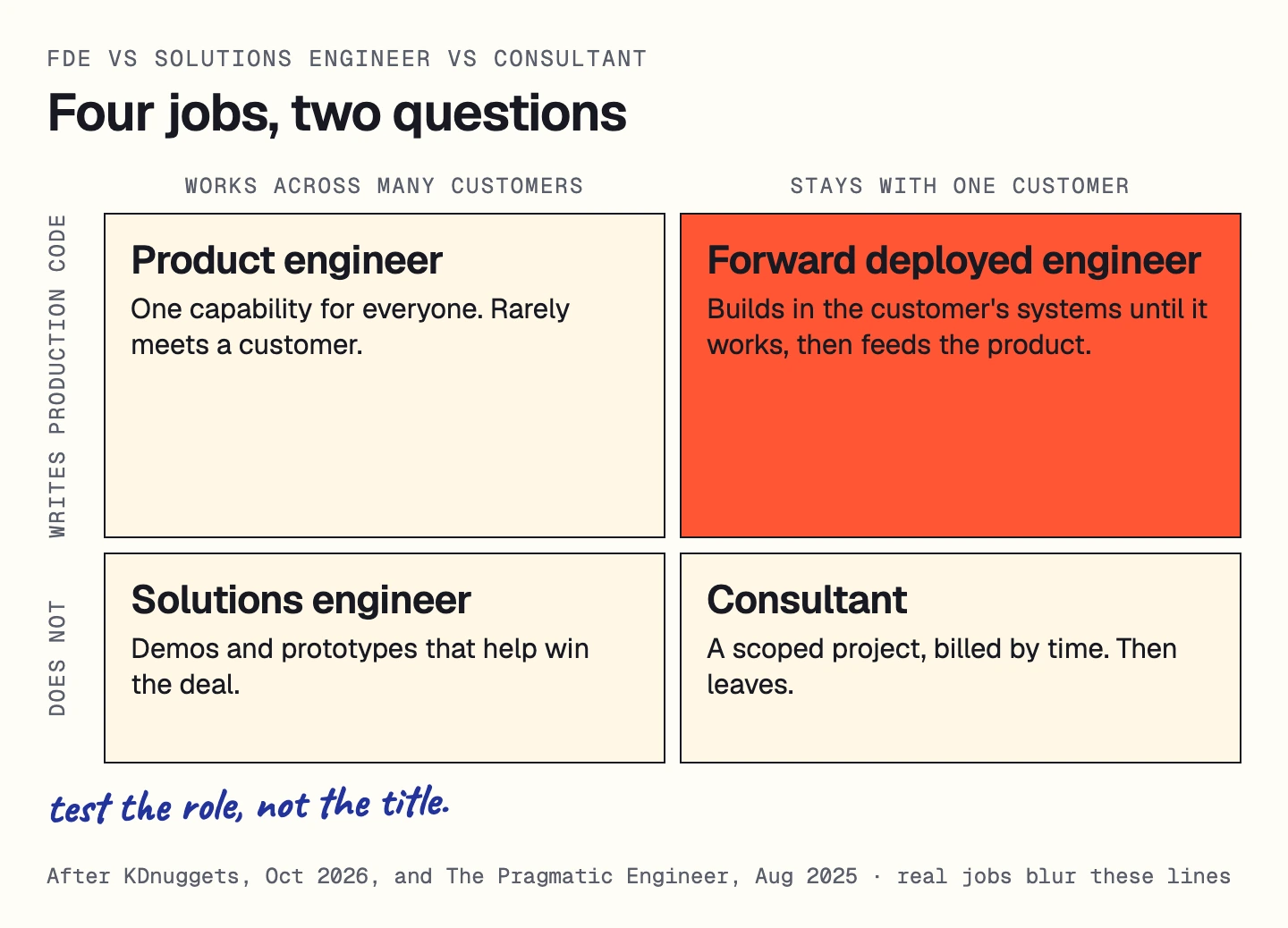
The neighbours, one by one:
- Solutions engineer or sales engineer. Demos and prototypes before the sale, sometimes with a sales target. Bloomberry's analysis of 1,000 forward deployed postings, cited by KDnuggets, found none that carried a quota.
- Solutions architect. Advises on design. At OpenAI, architects rarely write code in the customer's systems and forward deployed engineers do, The Pragmatic Engineer reports.
- Consultant. Delivers a scoped project, bills for time and leaves. Nothing flows back into a product.
- Product engineer. Builds one capability for every customer and rarely meets one.
- GTM engineer. Builds the systems a company's own revenue team runs on, before the sale. The GTM engineer guide covers that job.
The lines blur in real life. The Pragmatic Engineer found companies putting the forward deployed title on what is really a sales or consulting job. So test the role, not the title:
- Does it write production code?
- Does it stay with one customer until the thing works?
- Does its work change the product?
Three yeses is the real job. Two is a neighbour with a new badge.
What skills does a forward deployed engineer need?
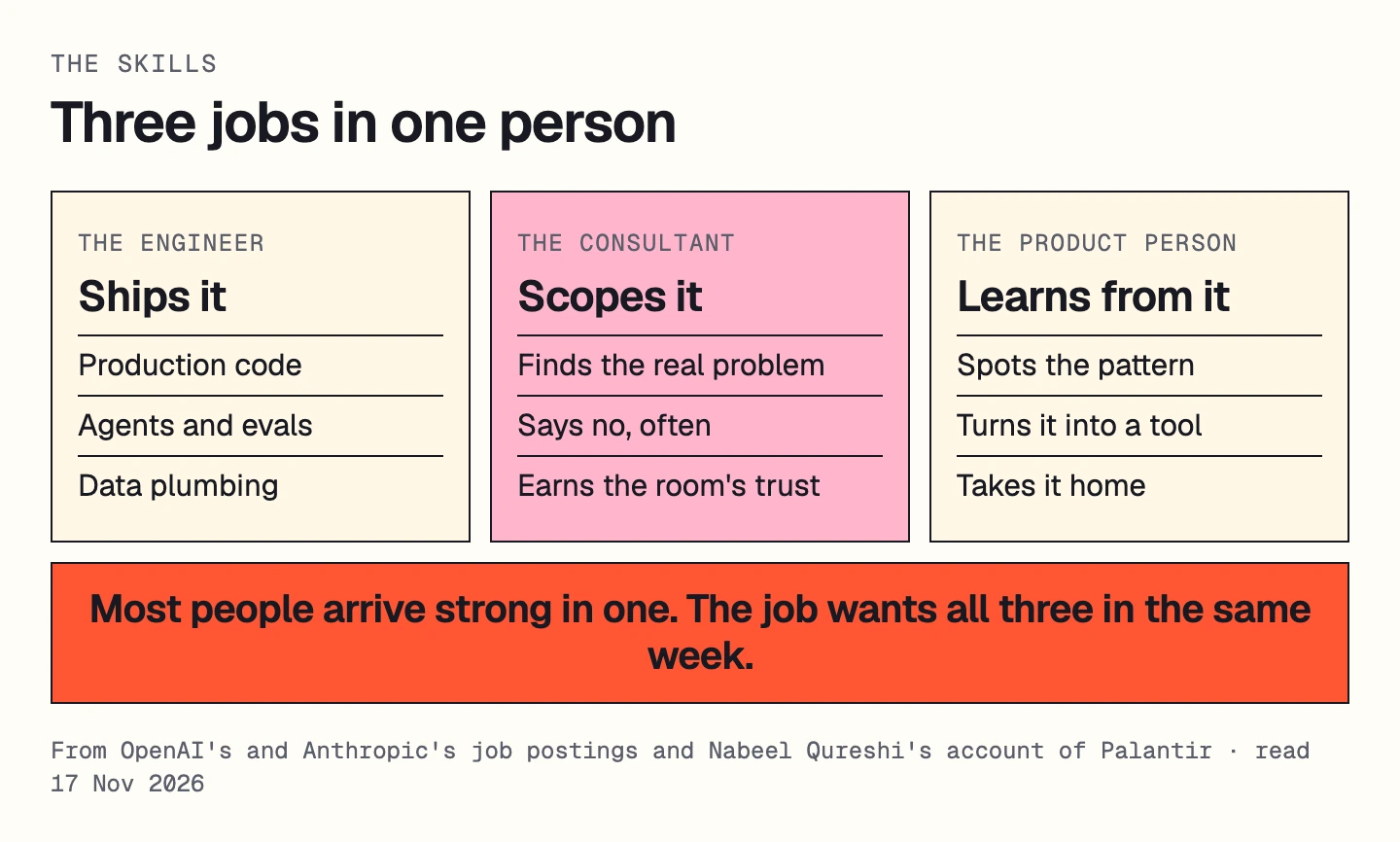
The job takes three skill sets at once: an engineer's, a consultant's and a product person's. Most people arrive strong in one and learn the other two on the job.
The engineer
You ship production code, usually Python plus a web stack, and you work with agents every day. Anthropic's posting asks for everyday use of AI coding tools, with the judgement to review and steer them. The guides for this part:
- AI agents explained and build your first agent
- Claude Code best practices and Claude Code vs Codex vs Gemini CLI
- MCP servers vs agent skills and the MCP server directory
- Context engineering, prompting and debugging with AI
The consultant
You turn a vague complaint into a problem you can build against. Anthropic describes it as walking into a conversation with only a business problem and leaving with a technical plan you can defend, for a secure system inside a complicated company. You also say no, often, and you say it to people senior to you.
The product person
You notice when three customers have the same problem and take that pattern home. Both labs write this into the job. OpenAI wants field feedback that changes its roadmaps, and working patterns turned into tools others can use. Anthropic wants repeatable deployment patterns written down and fed back to its product teams.
One more skill, which no posting lists: stamina. Qureshi writes that the good field engineers had a high tolerance for pain.
What tools do forward deployed engineers use?
They use coding agents to build, agent frameworks to structure the work, connectors to reach the customer's systems, and eval tools to prove it works. Nearly all of it is open source and on GitHub.
OpenAI's team describes the same kit from the inside: skills and plugins on top of a coding agent, connectors and MCP servers to reach each new team's systems, and fresh evals for every use case. The star counts below are from GitHub on 17 November 2026.
Coding agents. Where the building happens. Which one to pick has the comparison.
- Claude Code, Anthropic's terminal agent (156k stars)
- Codex, OpenAI's terminal agent (136k)
- Gemini CLI, Google's (109k)
Agent frameworks. For work that needs more than one prompt. The open-source agents directory has more.
- OpenAI Agents SDK (31k)
- Claude Agent SDK (9k)
- LangGraph (45k) and Pydantic AI (21k)
Connectors. How an agent reaches real systems. See MCP servers vs agent skills.
- The MCP reference servers (92k) and the MCP Python SDK (25k)
- Playwright MCP (40k) and Browser Use (121k), for work that only exists behind a web page
Evals and attacks. Proof that it works, and that it holds.
- promptfoo, tests and red teaming for prompts and agents (27k)
- Inspect, an evaluation framework from the UK government (3k)
- garak, NVIDIA's vulnerability scanner for language models (10k)
- Langfuse, traces and evals for agents in production (38k)
Data and automation. The plumbing.
- Airbyte, for moving data out of business systems (22k)
- DuckDB, for fast analysis on a laptop (43k)
- n8n, workflow automation with AI steps (211k)
- Ollama, for running models on your own machine when data cannot leave (187k). See the local model tools.
Learn one from each group before you learn a second from any. For what is new each week, the repo picks keep track.
How do you scope an AI deployment?
Scope a deployment by picking one workflow with an owner, agreeing what success means before building, and proving it on a small slice first.
OpenAI's deployment company describes the same order: a short diagnostic of where AI can create the most value, then a small number of priority workflows chosen with the customer's leadership, then the build.
A working checklist:
- Pick one workflow, not a department. It needs an owner who wants it fixed and can say yes.
- Watch the work being done. Process documents describe the official version. Sit with the person, or record the screen with their permission.
- Sort the tasks. Some an agent can finish alone. Some need a person working with an agent. Some should stay human. Where AI pays off has the tests.
- Agree the measure first. Which number moves, how you will count it, and what result would make you stop. See how to measure AI ROI.
- Price the run, not just the build. An agent costs money every time it works. When to use an agent and what it costs covers the sums.
- Name the gates early. Anthropic's posting tells its engineers to expect security and procurement gates. Find them in week one.
- Decide the handover on day one. Who runs it after you leave, and what they need to know.
The one-page scope
Before any build, write one page that both sides sign off:
- The workflow: what happens today, step by step, and who owns it.
- The change: which steps the system takes over, and which stay with a person.
- The measure: one number, its value today and the value that counts as success.
- The test: the cases the system must pass before it goes live.
- The limits: what the system may read, write, send and spend.
- The handover: who runs it, who fixes it, and when you leave.
If you cannot fill in the measure, you are not ready to build. For a wider audit of what a team already runs, the weekly loop note has a method.
How do you get a team using AI?
You get people using it by treating adoption as part of the build. OpenAI's posting makes its engineers responsible for guiding adoption of what they build, and counts production adoption as a measure of success.
This is the half of the job that engineers skip and customers remember. What works:
- Start with one team and a real task. A pilot people chose beats a licence everyone got. The rollout guide has the order.
- Teach the task, not the tool. People learn what they need this week. A first-week plan and how to stop learning and start using are written for them.
- Keep the stack small. Fewer tools, used daily. See which tools to pick.
- Keep a person in charge of anything that sends, spends or deletes. That is human in the loop, and it is what lets a nervous team say yes.
- Give people the words. Half of resistance is vocabulary. Send them 27 AI terms and the glossary.
KDnuggets names the uncomfortable part: the engineer answers for adoption they do not control. That is the reason to plan for it from the first meeting, and to put a named person from the customer's side in charge of it.
How do you test an AI agent?
Test an agent the way you would test a new hire with the keys to the building: decide what good work looks like, try to break it on purpose, and limit what it can touch.
- Write evals first. An eval is a test that scores how well the system does the job. OpenAI's validation phase is built on them, and its posting asks for feedback driven by evals.
- Know how agents fail. They loop, drift, invent results and stop early. Why AI agents fail in production lists the patterns and the fixes.
- Attack it. Red teaming means trying to make the system misbehave before a stranger does. Start with prompt injection, the attack that hides instructions in content the agent reads.
- Limit what it can touch. Six controls before agents act covers permissions, approvals and logs.
- Watch the browser. Agents that browse meet the open web. AI browsers compared tracks which ones have been tricked, and how.
A pre-launch checklist
- The evals pass on cases the system has never seen.
- Someone outside the build team has tried to break it.
- Every action that sends, spends or deletes waits for a person.
- Every run leaves a log a person can read.
- There is an off switch, and two people know where it is.
- The customer's team has run it for a week with you watching.
The longer an agent works alone, the more each of these matters. That raises the question of how long that is.
How long can AI agents work alone?
On tidy software tasks, the best model METR has measured succeeds half the time on work that takes a human expert about 17 hours. For work it must get right four times out of five, the figure is about 3 hours.
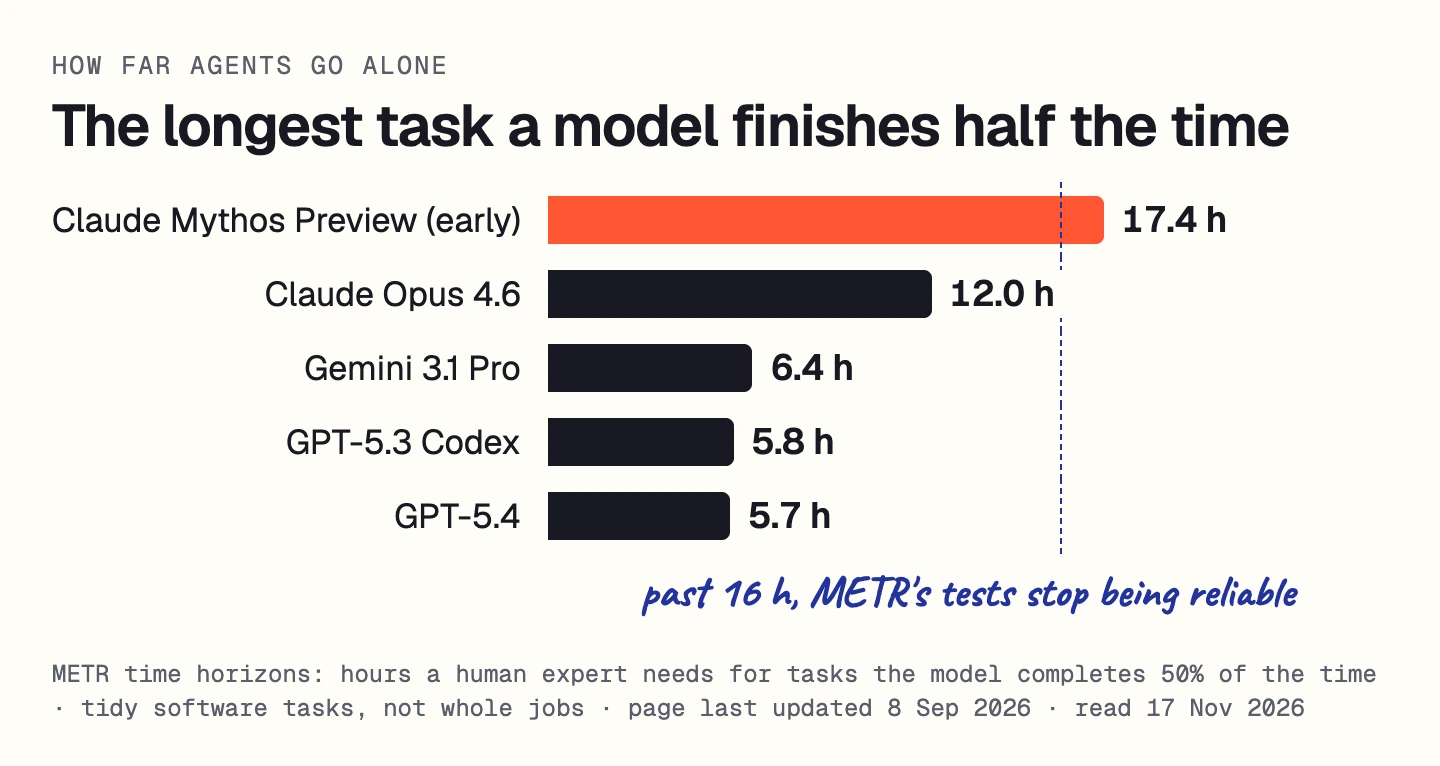
What METR's numbers say, from its time horizons page and the data file behind it:
- The newest entry is an early version of Claude Mythos Preview, released in April 2026, at about 17 hours. Claude Opus 4.6 is at about 12 hours.
- The pace. METR's 2025 paper found the horizon doubling about every seven months over six years. Its data file puts the pace since 2023 at about every four months.
- The limits. METR says measurements above 16 hours are unreliable with its current tasks, and the page is no longer actively updated.
What they do not say:
- Not how long an agent runs. The horizon is the length of the task in human time, not the agent's clock.
- Not real jobs. The tasks are tidy and self-contained. METR compares them to the work of a new hire with little context, and says real jobs are messier.
- Not reliability. Half the time is a coin toss. Nobody puts a coin toss in charge of payroll.
Read it as a forecast for this job. Each doubling moves more of the building from the person to the agent. What stays with the person is choosing the task, setting the test and answering for the result. That is the forward deployed engineer's half of the work, and it is the half that is growing.
OpenAI's team says the same from the inside. In one case the first deployment took two months and the second team took a day. Jarvis writes that if the team makes itself obsolete every couple of months, it is doing its job.
How much do forward deployed engineers make?
In the United States, two job-data firms put typical advertised pay between about $170,000 and $190,000 a year, and the AI labs post far higher.
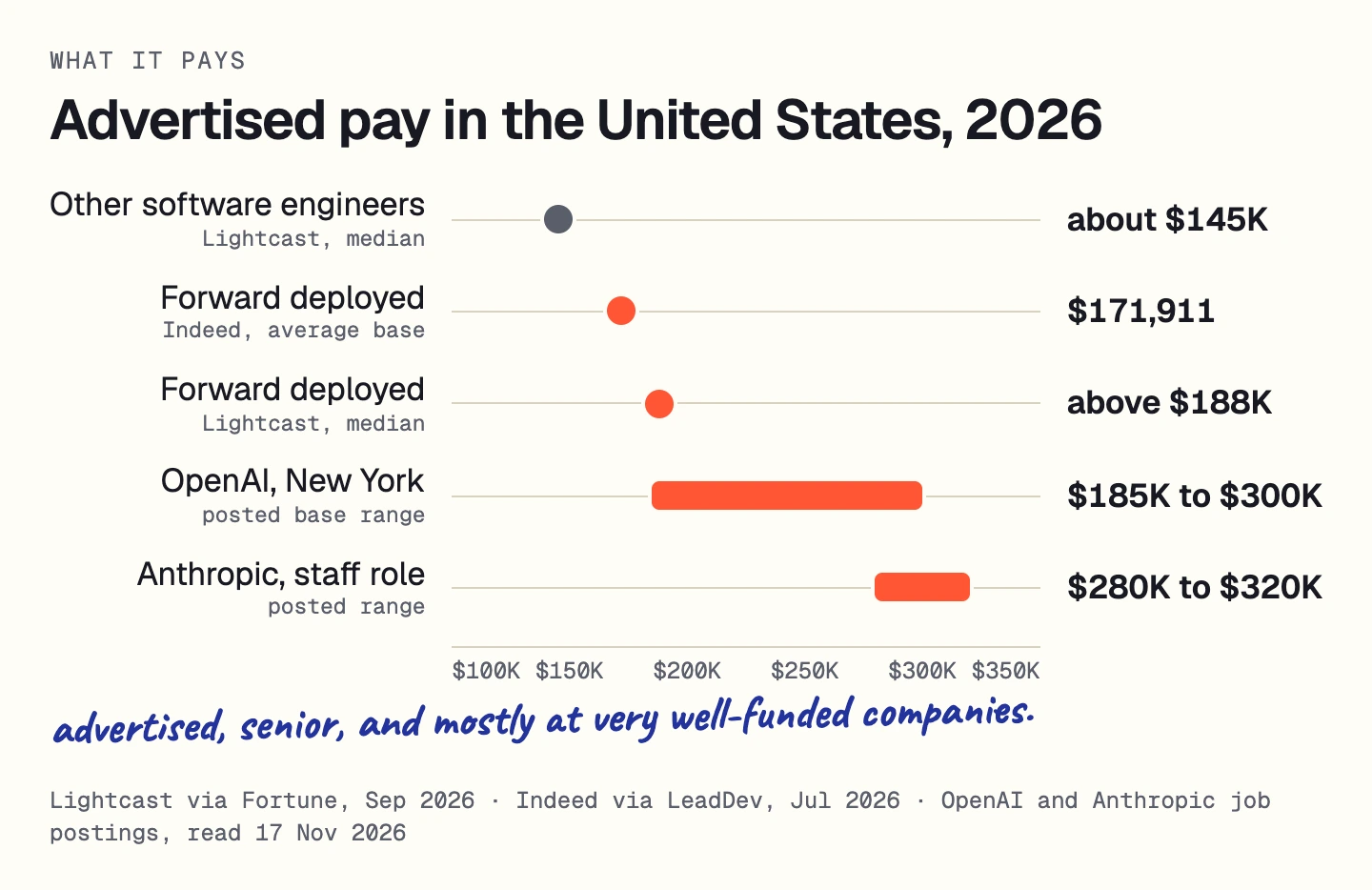
- Lightcast: a median advertised salary above $188,000, against about $145,000 for other software engineers, as Fortune reported in September 2026.
- Indeed: an average base salary of $171,911, as LeadDev reported in July 2026.
- OpenAI: $185,000 to $300,000 base, plus equity, for a forward deployed engineer in New York.
- Anthropic: $280,000 to $320,000 for a staff forward deployed engineer.
Treat every figure with care:
- They are advertised ranges in the United States, mostly at well-funded AI companies.
- Many headline numbers come from recruiters, who gain from the excitement. KDnuggets makes this point.
- These are senior jobs. LinkUp warns that they ask for senior skill and are a poor landing spot for new graduates.
How do you become a forward deployed engineer?
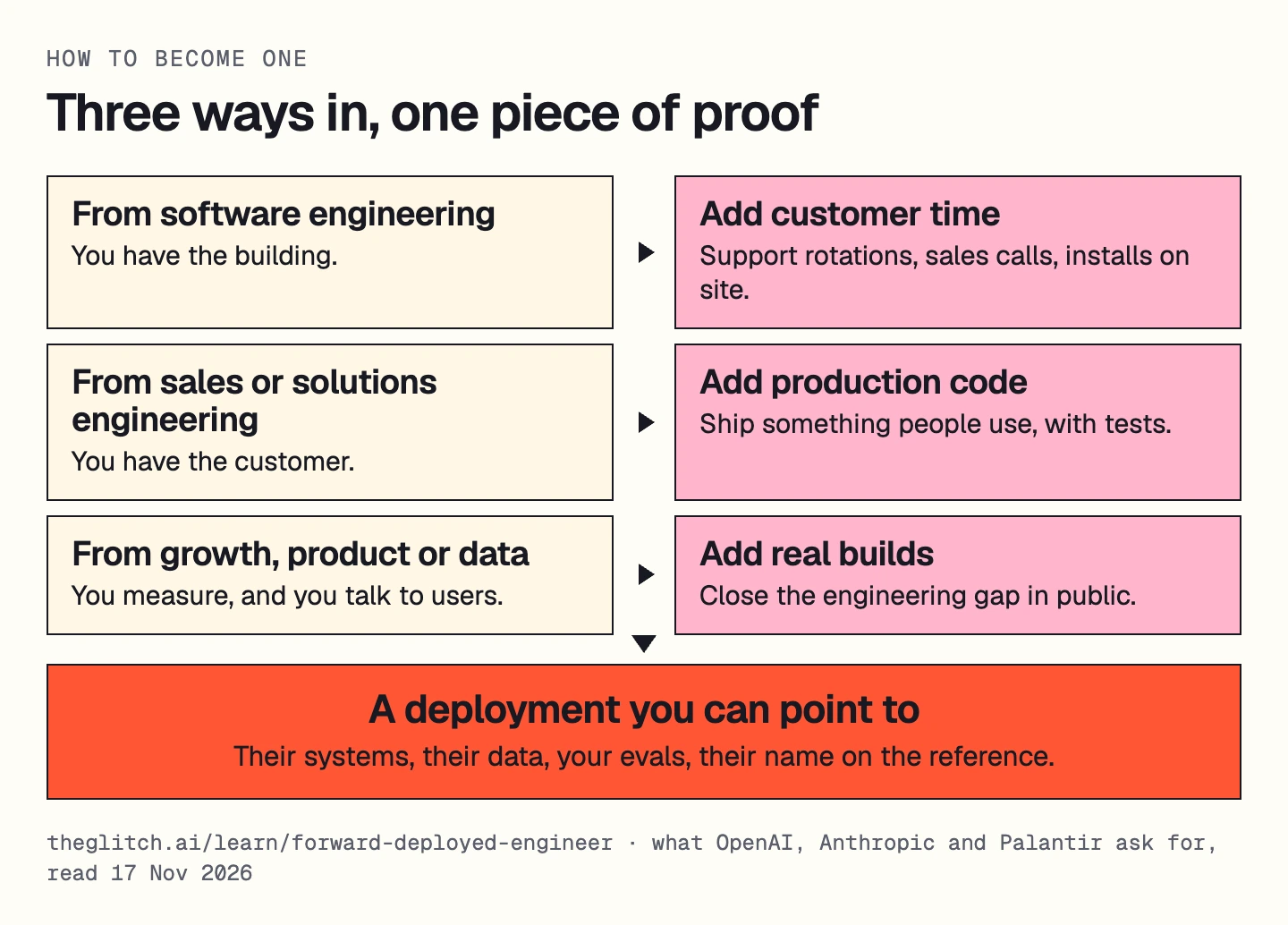
You become one by proving two things: that you can ship working software, and that you can do it in front of a customer. The title matters less than the evidence.
Who gets hired, according to the companies:
- OpenAI asks for five or more years of engineering or technical deployment work that included customers, plus experience building with language models.
- Anthropic accepts senior customer-facing technical people, tech leads with consulting or product experience, and former technical founders. Its staff posting says side projects and prototypes count as agent experience.
- Palantir has hired people with as little as one year of work after university, The Pragmatic Engineer reports.
Three routes into the job
- From software engineering. You have the building. Go and get customer time: support rotations, sales calls, installs on site.
- From sales or solutions engineering. You have the customer. Ship something to production, with tests, that people use.
- From growth, product or data. You have the habit of measuring and the habit of talking to users. Close the engineering gap with real builds.
The third route is underrated. If the first agents in smaller companies go into growth work, as Saraev argues, a growth engineer already knows where that work hurts. My own route ran from growth engineering to forward deployed engineering.
A 90-day plan
- Build one agent that does a dull job end to end. Use the first agent guide.
- Write evals for it and publish the failures. A build log beats a certificate. This site keeps one in the notes.
- Deploy it for a real team. A friend's business counts. Their systems, their data, their complaints.
- Write up the scope, the test and the result on one page.
- Do it again in a second industry. Two is a pattern.
What to put in a portfolio
- A system someone else runs, with their name on the reference.
- The one-page scope and the measure, before and after.
- The eval set, with the cases that failed.
- What you would do differently, in plain words.
Courses and training
- Anthropic's academy. A course of several days in person, built around a simulated deployment that runs from choosing the use case through the security review to the handover, with a graded practical at the end. Then a twelve-week residency leading a real project at your own employer. Entry is by an employer's nomination, and the first graduates are expected in early 2027.
- Paid courses. Bootcamps and course sellers multiplied in 2026. Check who teaches, and whether you finish with a deployed system or only a certificate.
- The free route. The guides on this site, in the order of the 90-day plan.
None of them replaces a deployment you can point to.
What is the forward deployed engineer interview like?
Expect to be tested on breaking down a vague problem in front of someone, as well as on code. Palantir's loop is the best documented, in guides built from candidates' reports.
According to Aced's candidate guide, Palantir runs a recruiter call, then three 60-minute rounds, then a final round with a hiring manager. The three rounds are drawn from five types:
- Decomposition: take a vague real-world problem and break it into parts you could build.
- Learning and re-engineering, two rounds most big-tech loops do not have.
- Coding and system design, the familiar ones.
Aced adds that the final round returns to your weakest area, that the process commonly takes three to four weeks, and that AI tools are not allowed. Your loop may differ.
Anthropic's posting describes the same skill from the employer's side: walk into a discovery conversation with only a business problem, and walk out with a technical plan you can defend. Practise that out loud:
- Take a process you know, such as refunds in a shop.
- Say who does what, and where it breaks.
- Say what you would build first, and what you would leave alone.
- Say how you would know it worked.
Is forward deployed engineering a good career?
It is a good career if you like shipping things for real people and can live with mess. It is a poor one if you want deep, quiet engineering work.
The downsides, from people who looked closely:
- Some of these jobs are not engineering. The Pragmatic Engineer spoke to two engineers who were disappointed. One left after four weeks and described the work as IT services.
- You carry the customer. Unclear requests, changing scope, and a project that does not ship is your problem.
- Travel and context switching. Up to half your time away, at some employers.
- You may sit outside the core. Engineers hired into separate deployment companies may not share in the parent company's upside, The Pragmatic Engineer notes.
- Skills can narrow. KDnuggets warns that two years of integration work can make a return to core product engineering harder.
A recruiter quoted by the Wall Street Journal, and picked up by The Pragmatic Engineer, put it bluntly: about one engineer in ten wants the job, and every company wants the engineers.
Questions to ask before you accept an offer:
- Does anything built for one customer become part of the product?
- Who decides when an engagement ends?
- How is my work measured: adoption and results, or hours billed?
- How much of the week is code?
- Which company's shares do I get?
Should you hire a forward deployed engineer?
Hire one if your AI plans cannot work without deep fitting into how your company runs, and you can pay for a senior person to do it. If a normal purchase and a short setup would do, do not.
PostHog's rule is a good first filter: if the usual way of selling and onboarding already works, do not add forward deployed engineers. They make sense when the product needs heavy implementation, when the industry is tightly regulated, or when a company is entering a new kind of customer.
Your options:
- Grow one inside. Pick the engineer who already talks to the business, and give them one workflow and a deadline. Anthropic's academy is built on this idea: employers nominate their own engineers.
- Borrow one. The model vendors now sell this through their deployment ventures and partners, mostly to large firms.
- Hire one. Expect senior pay and a thin market.
- Bring in an independent. One person or a small team for a fixed scope, with the handover written into the contract.
Whoever does the work, ask them these before they start:
- Which one workflow are we starting with, and who owns it?
- What number will move, and how will we count it?
- What will the system be allowed to touch?
- What do we run ourselves on the day you leave?
One sceptic quoted by LeadDev expects companies to bring this work in-house over time. Plan for that from the start, and judge every outside helper by what your own team can run afterwards. If you want a second pair of hands on a deployment, that is the work I do.
Who should you follow and watch?
Follow the people who do this work or report on it first-hand. These are the ones this guide leans on.
Watch:
- The FDE Playbook for AI Startups: Bob McGrew, an early Palantir executive, explains the model on Y Combinator's channel.
- Nick Saraev: the independent operator's side. How to find the work inside a small business and build it with agents.
- The Pragmatic Engineer: Gergely Orosz's interviews with working engineers. His written pieces on this job are the best reporting on it.
- AI Engineer: conference talks from people building agents and evals.
Read:
- Colin Jarvis, What FDE means at OpenAI: the head of the team, with real projects and numbers.
- Nabeel Qureshi, Reflections on Palantir: what the job was like where it started. He goes deeper in an interview with Lenny Rachitsky.
- Hamel Husain, AI evals: everything you need to know: the testing half of the job.
- Simon Willison on prompt injection: a long record of the attack and what does not fix it.
- METR's time horizons: how far agents get on their own.
Keep up: the radar checks the week's AI news, and Latest lists everything new on this site.
What should you read next?
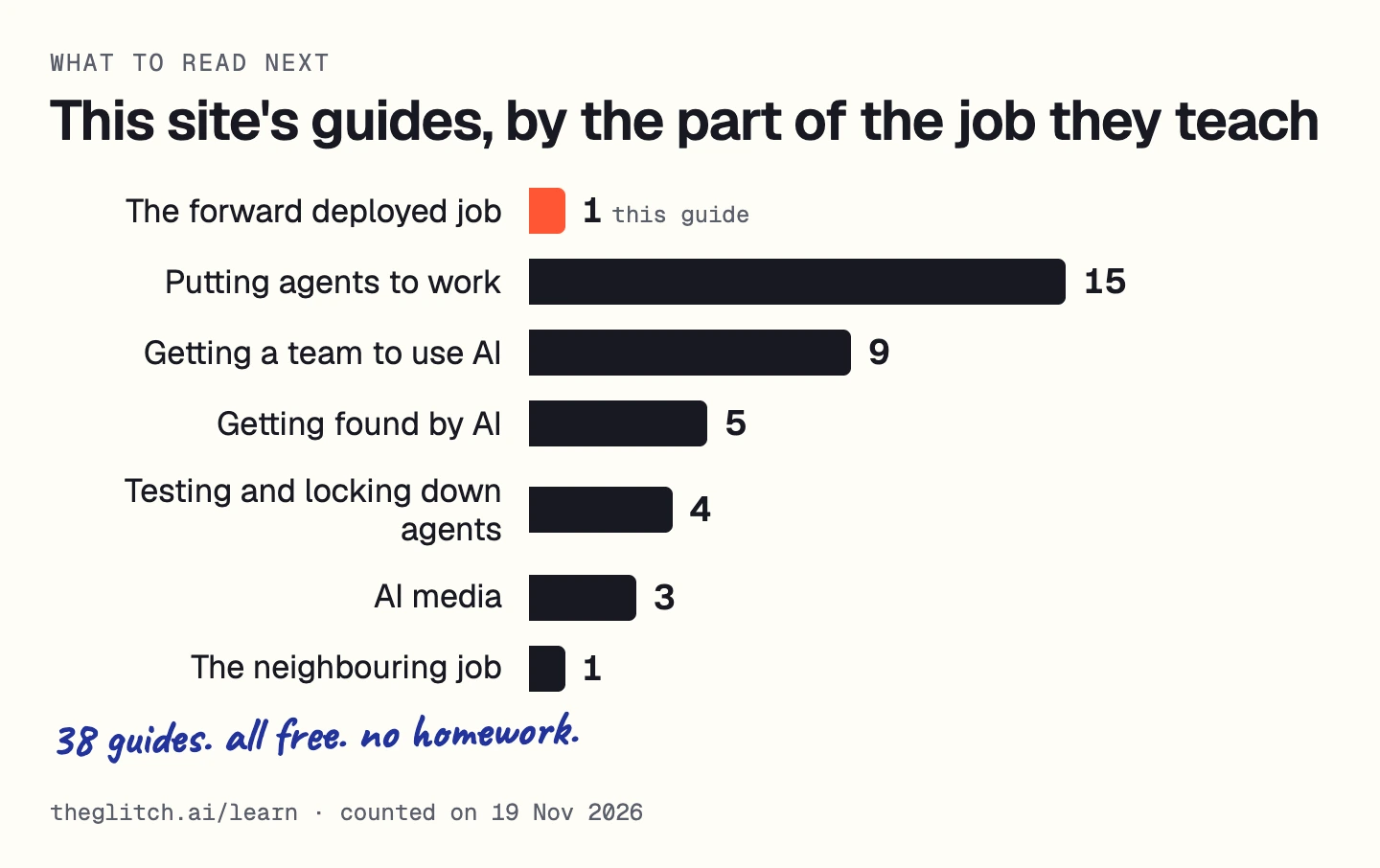
Read the part of this site that matches the gap you just found. Every other guide here is listed below, grouped by the part of the job it teaches.
Putting agents to work
- AI agents explained, build your first agent and agents for growth teams
- Claude Code best practices, Claude Code vs Codex vs Gemini CLI and debugging with AI
- MCP servers vs agent skills and the best MCP servers
- Prompting and context engineering
- Building apps without code and the AI app builders
- The open-source agents, voice agent platforms and local model tools
Getting a team to use AI
- How to get good at AI fast, a first-week plan and stop learning, start using
- Which tools to pick and 27 AI terms to know
- Where AI pays off, rolling it out and measuring the return
- The AI note takers, often a team's first easy win
Testing and locking down agents
- Why AI agents fail in production and six controls before agents act
- Prompt injection explained and the AI browsers
Getting found by AI
- Getting cited by AI search, the AI visibility audit and writing content AI will quote
- What WebMCP is and how to add it to a site
AI media
The neighbouring job
- What is a GTM engineer? The engineer who builds for a company's own revenue team.
The shelves
- The AI glossary: every term used here, in plain English.
- The prompt library: prompts to copy, with their sources.
- The radar: this week in AI, checked.
- Repo picks and bookmarks: what is worth opening.
- The notes: this site's own build log.
- The prompt workbench: turn a rough idea into a brief.
- Latest: every dated piece, newest first.
This site also practises what the guide describes. It hands agents a set of tools they can call, and its guides and notes record what went wrong along the way.
What's happening now
- OpenAI explained how its team works. Colin Jarvis, who founded OpenAI's forward deployed team in early 2025, published how it works, with customer cases: one first deployment took two months and the second team took a day. OpenAI
- Anthropic will train 10,000 engineers. Anthropic launched Claude Frontier Academy with a $100 million commitment to train 10,000 Frontier Deployed Engineers by the end of 2027. Engineers join by nomination from their employer. Anthropic
- Lightcast: postings up more than tenfold. Fortune reported Lightcast data putting forward deployed postings from January to August 2026 at more than ten times the same months of 2025, with a median advertised salary above $188,000. Fortune
- LinkUp counts more than 5,000 listings. LinkUp found listings naming forward deployed engineers or architects flat at about 300 through 2022 and 2023, then above 5,000 by early 2026, almost all of the rise in one year. LinkUp
- OpenAI launched a deployment company. OpenAI launched the OpenAI Deployment Company with more than $4 billion of investment and agreed to buy Tomoro, bringing about 150 forward deployed engineers and deployment specialists. OpenAI
- Anthropic formed a services venture. Anthropic announced a joint venture for enterprise AI services, with Blackstone, Hellman & Friedman and Goldman Sachs as founding partners. The Wall Street Journal reported a $1.5 billion valuation. TechCrunch
- Many engineers do not want the job. The Pragmatic Engineer reported that postings had surged while many engineers avoided the role, because some versions of it involve little software work. The Pragmatic Engineer
- a16z named it the hottest startup job. Andreessen Horowitz argued that AI application companies should accept lower margins from hands-on deployment work in exchange for becoming hard to replace. Andreessen Horowitz
Fresh from This week in AI
| Main goal | Writes production code | Feeds the product | |
|---|---|---|---|
| Forward deployed engineer | Make it work inside one customer | Yes, in the customer's systems | Yes, that is the point |
| Solutions engineer | Help win the deal | Demos and prototypes | Sometimes |
| Consultant | Deliver a scoped project | Rarely | No |
| Product engineer | One capability for every customer | Yes, in the core product | Yes, directly |
Boss fight
A customer needs a feature nobody else has asked for. What makes building it forward deployed work?
- Building it fast
- Building it, then feeding what you learned back to the product
- Billing for it by the hour
Answer: Building it, then feeding what you learned back to the product. The loop back to the product is the test. Without it, the job is consulting with a new title.
METR's newest listed model has a 50% time horizon of about 17 hours. What does that mean?
- It can run alone for 17 hours
- It succeeds half the time on tasks that take a human expert about 17 hours
- It can do any job that takes 17 hours
Answer: It succeeds half the time on tasks that take a human expert about 17 hours. The horizon is the length of the task in human time, on tidy software tasks, at a coin toss of success.
What comes first in a deployment?
- The agent
- The demo
- An agreed measure of what working means
Answer: An agreed measure of what working means. Agree the test before the build, or nobody can say whether it worked.
Questions people ask
What does FDE stand for?
FDE stands for forward deployed engineer: a software engineer who works inside a customer’s business and builds AI systems there until they run in production. Palantir, which created the role, uses the longer title forward deployed software engineer. Anthropic’s training programme calls its graduates Frontier Deployed Engineers, with the same three letters.
Is a forward deployed engineer a real engineer or a consultant?
A real engineer, when the job is done properly. The role writes production code in the customer’s systems, stays until the system works, and feeds what it learned back into the product. A consultant delivers a scoped project and leaves. Some companies do put the title on consulting or sales work, so check those three things before accepting an offer.
How much does a forward deployed engineer earn?
In the United States, Lightcast found a median advertised salary above $188,000 and Indeed an average base salary of $171,911. The AI labs post more: OpenAI lists $185,000 to $300,000 plus equity for a role in New York, and Anthropic lists $280,000 to $320,000 for a staff role. These are advertised figures for senior jobs at well-funded companies.
What is the difference between an FDE and a solutions engineer?
A solutions engineer works before the sale, with demos and prototypes that help win the deal, and sometimes carries a sales target. A forward deployed engineer works after it, writing production code inside the customer’s systems until the product does its job. One analysis of 1,000 forward deployed postings found none that carried a quota.
How do I become a forward deployed engineer without experience?
Start by building proof. Make one agent that does a dull job end to end, write evals for it, deploy it for a real team, and write up the scope, the test and the result on one page. Then do it again in a second industry. Employers hire for shipped software and time with customers, and these are senior jobs, so most people arrive from engineering, sales engineering, growth, product or data.
Which companies hire forward deployed engineers?
Palantir created the role and still hires for it. OpenAI and Anthropic both run forward deployed teams, and each launched a separate deployment venture in May 2026. Fortune counted open roles at Microsoft, Meta and Google as well. Listings also appear under other titles, such as applied AI engineer, so search by the work and not only by the name.
How much does a forward deployed engineer travel?
It depends on the employer. Palantir’s posting asks for 25 to 50% travel, Anthropic’s says about 25%, and OpenAI’s says up to 50%. Early Palantir engineers worked from customer offices three to four days a week. Ask about travel in the interview, because it shapes the job more than the title does.
Can someone from growth or marketing become an FDE?
Yes, if they can build. The job needs working software and time with customers, and people from growth, product or data already measure results and talk to users. The gap to close is engineering: ship real systems, with tests, that other people run. In smaller companies the first agents often go into growth work, which is ground a growth engineer already knows.
Will AI agents replace forward deployed engineers?
Not on current evidence. The best model METR has measured succeeds half the time on tidy software tasks that take a human expert about 17 hours, and real jobs are messier than those tasks. As agents take on more of the building, what stays with a person is choosing the task, setting the test and answering for the result. That is the forward deployed half of the work.
Is forward deployed engineer a good career in 2027?
It is a strong bet if you like shipping for real people and can live with mess. Postings grew more than tenfold in a year by several counts, pay is high, and Anthropic plans to train 10,000 engineers for this work by the end of 2027. The risks are real too: travel, unclear scope, and some jobs that carry the title without the engineering.
Key terms
Agent · Evaluation · Human in the loop · Red teaming · Prompt injection · Context engineering · Model Context Protocol · AI pilot · AI ROI · Coding agent
Try it here
AI glossary · Prompt library · Prompt workbench
Sources
- OpenAI: Forward Deployed Engineer (FDE), New York City (job posting)
- OpenAI: OpenAI launches the OpenAI Deployment Company
- OpenAI: What FDE means at OpenAI, by Colin Jarvis
- Anthropic: Staff Forward Deployed Engineer (job posting)
- Anthropic: Claude Frontier Academy
- Palantir: Forward Deployed Software Engineer (job posting)
- Nabeel S. Qureshi: Reflections on Palantir
- The Pragmatic Engineer: What are Forward Deployed Engineers, and why are they so in demand?
- The Pragmatic Engineer: Forward deployed engineering heats up again
- The Pragmatic Engineer: Is the FDE role becoming less desirable?
- Andreessen Horowitz: Why the Forward Deployed Engineer Is the Hottest Job in Startups
- PostHog: WTF is a forward deployed engineer?
- KDnuggets: Forward Deployed Engineer: AI's Hottest New Career, or Consulting With a Better Title?
- LinkUp: Inside the AI Revolution
- LeadDev: The rise of the forward-deployed engineer
- Fortune: One of the fastest-growing jobs in Silicon Valley
- TechCrunch: Anthropic and OpenAI are both launching joint ventures for enterprise AI services
- METR: Task-Completion Time Horizons of Frontier AI Models
- METR: Measuring AI Ability to Complete Long Tasks
- Google Trends: forward deployed engineer, past five years
- Aced: Palantir Forward Deployed Engineer interview guide
- Nick Saraev: The Highest-Paying Careers for The Next 2+ Years (video)