Open-source AI agents worth trying in 2027.
Eighteen open-source agents and agent frameworks, from OpenClaw and Hermes to LangGraph and browser-use, grouped by job with live GitHub numbers.
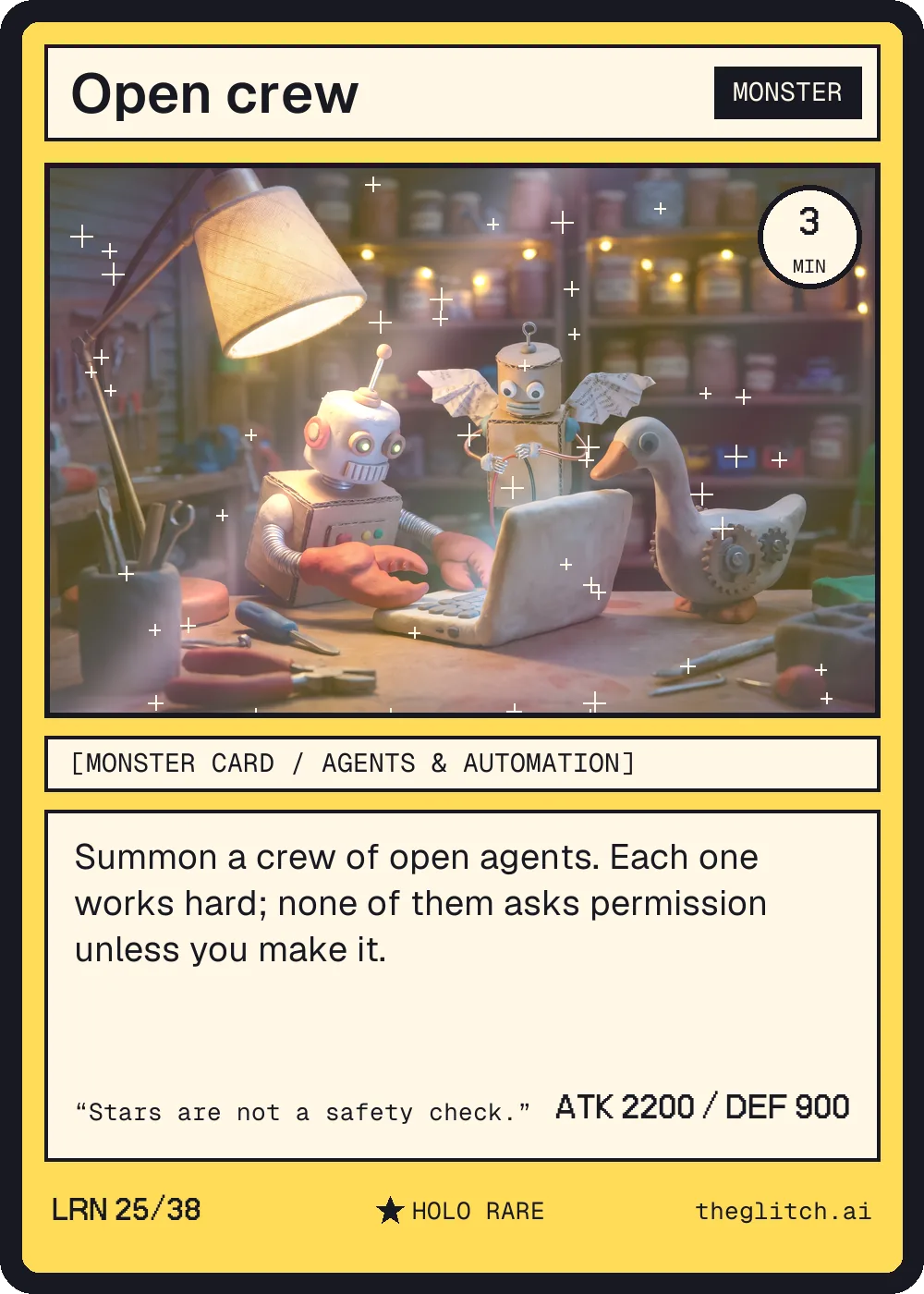
By Rabin Nuchtabek · Updated 2026-11-04 · 3 min read · For Creators, Builders, Leaders
Part of What is a forward deployed engineer? The ultimate guide to becoming one in 2027
Open-source agents went from weekend demos to daily tools. The two personal agents at the top of this list have hundreds of thousands of GitHub stars each, and plenty of custom agents are built on a handful of open frameworks. This is the short list worth trying going into 2027, grouped by the job you'd give them. Star counts, licences and languages are as GitHub listed them on 4 November 2026.
Personal agents that do things
These run on your own machine and act for you across apps: messages, files, browsers and forms. They are the most fun and the most dangerous to set up, because an agent with your logins can do real damage.
- OpenClaw: "the AI that really does things", on any OS and any platform. 393,820 stars, MIT licence, TypeScript.
- Hermes Agent from Nous Research: "the agent that grows with you", a personal agent you run yourself. 260,126 stars, MIT, Python.
Start either one with the fewest permissions you can, and widen them only after it has earned them. Lock down your agents before they act shows how.
Coding agents
These read a repository, run commands, edit files and test their own work.
- OpenHands: AI-driven development: an open-source agent for software tasks. 92,576 stars, MIT, TypeScript.
- Cline: an autonomous coding agent you can use as an SDK, an editor extension or a command-line assistant. 71,256 stars, Apache-2.0, TypeScript.
- Goose: an extensible agent that goes beyond code suggestions: it installs, executes, edits and tests. 56,174 stars, Apache-2.0, Rust.
- Aider: AI pair programming in your terminal. 49,922 stars, Apache-2.0, Python. Its last push to GitHub was in May 2026, so check how active it is before you rely on it.
Frameworks to build your own
Pick these when you're building an agent into a product. Choose by who will maintain it, not by the demo.
- LangGraph: build resilient agents as graphs of steps you control. 44,398 stars, MIT, Python.
- CrewAI: a framework for teams of role-playing agents that work together on a task. 60,453 stars, MIT, Python.
- AutoGen from Microsoft: a programming framework for agentic AI. 61,690 stars, Python; GitHub lists its licence as CC-BY-4.0, so read the repository's licence files before shipping.
- smolagents from Hugging Face: a barebones library for agents that think in code. 30,199 stars, Apache-2.0, Python.
- Agno: an agent platform for building and running agents. 43,033 stars, Apache-2.0, Python.
- Mastra: a TypeScript framework for AI applications and agents. 29,309 stars; check its licence terms in the repository.
- OpenAI Agents SDK: a lightweight framework for multi-agent workflows. 30,476 stars, MIT, Python.
- Claude Agent SDK: Anthropic's Python SDK for building agents. 8,419 stars, MIT.
- Agent Development Kit from Google: a code-first Python toolkit for building, evaluating and deploying agents. 22,090 stars, Apache-2.0.
Whichever you choose, the parts are the same: a model, tool calling, an agent harness with permissions and stopping rules, and agent memory.
Browsers, memory and workflows
- browser-use: an open-source Python library for agents that work in a web browser, with a hosted cloud alongside. 119,934 stars, MIT.
- Letta: a platform for stateful agents with long-term memory that can learn over time. 25,331 stars, Apache-2.0.
- n8n: fair-code workflow automation with native AI, mixing visual building with custom code. 209,445 stars. Fair-code isn't the same as open source, so read the licence before you build a business on it.
How to pick one
- Want an agent working for you this week? Try a personal agent on a spare machine or account, never your main inbox on day one.
- Want help with code? Start with a coding agent inside one repository and review every diff.
- Building a product? Prototype the same small task in two frameworks and keep the one your team can read and debug.
- Connecting tools? Check for Model Context Protocol support: one MCP connector can then serve several agents.
- Before you install anything, remember that stars measure attention, not safety. Read the licence, skim the code, give the agent least privilege and keep a log of what it does.
New to agents? Read AI agents, minus the hype first, then Build your first agent, the boring way.
Fresh from This week in AI
Grok Bot is the iPhone of the personal agent world
Hermes is your Android option
| Use it for | Licence | Stars, Nov 2026 | |
|---|---|---|---|
| OpenClaw | A personal agent that acts on any OS | MIT | 393,820 |
| Hermes Agent | A personal agent that grows with you | MIT | 260,126 |
| browser-use | Agents that work in a web browser | MIT | 119,934 |
| OpenHands | An open-source agent for software tasks | MIT | 92,576 |
| Cline | Coding in your editor or terminal | Apache-2.0 | 71,256 |
| LangGraph | Building your own agent with control | MIT | 44,398 |
Questions people ask
What is an open-source personal AI agent like OpenClaw?
A personal agent runs on your own machine and acts for you across apps, handling messages, files, browsers and forms. OpenClaw and Hermes Agent are the two listed, both under the MIT licence. Because an agent with your logins can do real damage, start it with the fewest permissions you can and widen them only after it has earned them.
How do I choose an open-source agent framework for my product?
Prototype the same small task in two frameworks and keep the one your team can read and debug. Choose by who will maintain it, not by the demo. Options include LangGraph, CrewAI, AutoGen, smolagents, Agno, Mastra and the OpenAI, Claude and Google agent kits. Each still needs a model, tool calling, an agent harness with permissions and stopping rules, and agent memory.
Is a GitHub project with many stars safe to install?
No, stars measure attention, not safety. Before you install any agent, read the licence, skim the code, give the agent least privilege and keep a log of what it does. Also check how active a project is: Aider, for example, last pushed to GitHub in May 2026, so confirm it is still maintained before you rely on it.
What licence mistakes should I avoid with open-source AI agents?
Do not assume every popular agent project is standard open source. GitHub lists AutoGen's licence as CC-BY-4.0, Mastra's terms need checking in its repository, and n8n is fair-code, which is not the same as open source. Read the repository's licence files before you ship a product or build a business on any of them.
How should I prepare for open-source AI agents in 2027?
Start small and with low permissions now. Try a personal agent on a spare machine or account rather than your main inbox, and use a coding agent inside one repository while reviewing every diff. Check tools for Model Context Protocol support, since one MCP connector can serve several agents, and stop treating star counts as a sign of safety.
Key terms
Agent · Tool calling · Agent harness · Agent memory · Model Context Protocol · Least privilege
Try it here
Repos worth building on · Skills and workflows