Build your first agent, the boring way.
Pick a dull task, build it as a workflow, run it in suggest mode and only then hand over the keys. A step-by-step plan for a first agent that lasts.
By Rabin Nuchtabek · Updated 2026-10-29 · 3 min read · For Builders, Marketers
Part of What is a forward deployed engineer? The ultimate guide to becoming one in 2027
Your first agent should be boring. Not a "chief of staff that runs your life". Something like: every morning, check five competitors' pricing pages and post what changed to a Slack channel. Boring agents ship. Ambitious first agents become demos that quietly die.
Pick the right first task
A good first task is:
- Repetitive. It happens daily or weekly, so the time saved adds up.
- Low stakes. A wrong output is annoying, not dangerous. Nothing reaches customers yet.
- Checkable. You can tell at a glance whether the result is right.
- Bounded. It has a clear start and finish.
Good examples: a daily digest of new support tickets, enriching new leads with public company information, tagging and routing inbound email, turning meeting transcripts into action lists, watching pages for changes.
Bad first agents: anything that messages customers, moves money, deletes data or needs judgment you can't describe.
Step 1: Write the job description
Before you open any tool, write half a page: the trigger (a schedule, a new row, an incoming email), the inputs, the steps a person takes today, the output, where the output goes and how you'll know it worked. If you can't write this, the agent can't do the job either.
Step 2: Build it as a workflow first
Map the steps in a builder like n8n, Zapier or Make, or in code if you have engineers. Put the model only where judgment is needed: "summarize", "classify", "extract these fields". Keep everything else as plain automation. This version is cheaper, easier to debug and often good enough (workflow). That's a win, not a failure.
Step 3: Add agency where steps vary
If some cases need different steps, like looking something up or trying another source when the first one fails, give the model tools and let it choose. Keep the tool list short and each tool's description clear. Set hard limits: maximum steps per run, maximum spend, a timeout.
Step 4: Test with real data
Run it on twenty real past cases where you know the right answer. Write down every failure. The usual first-week problems: the model invents a field that wasn't in the source (hallucination), a website blocks the scraper, an input arrives in a format nobody planned for. Fix, rerun, repeat. Keep those twenty cases. They're your golden dataset for every future change.
Step 5: Run in suggest mode
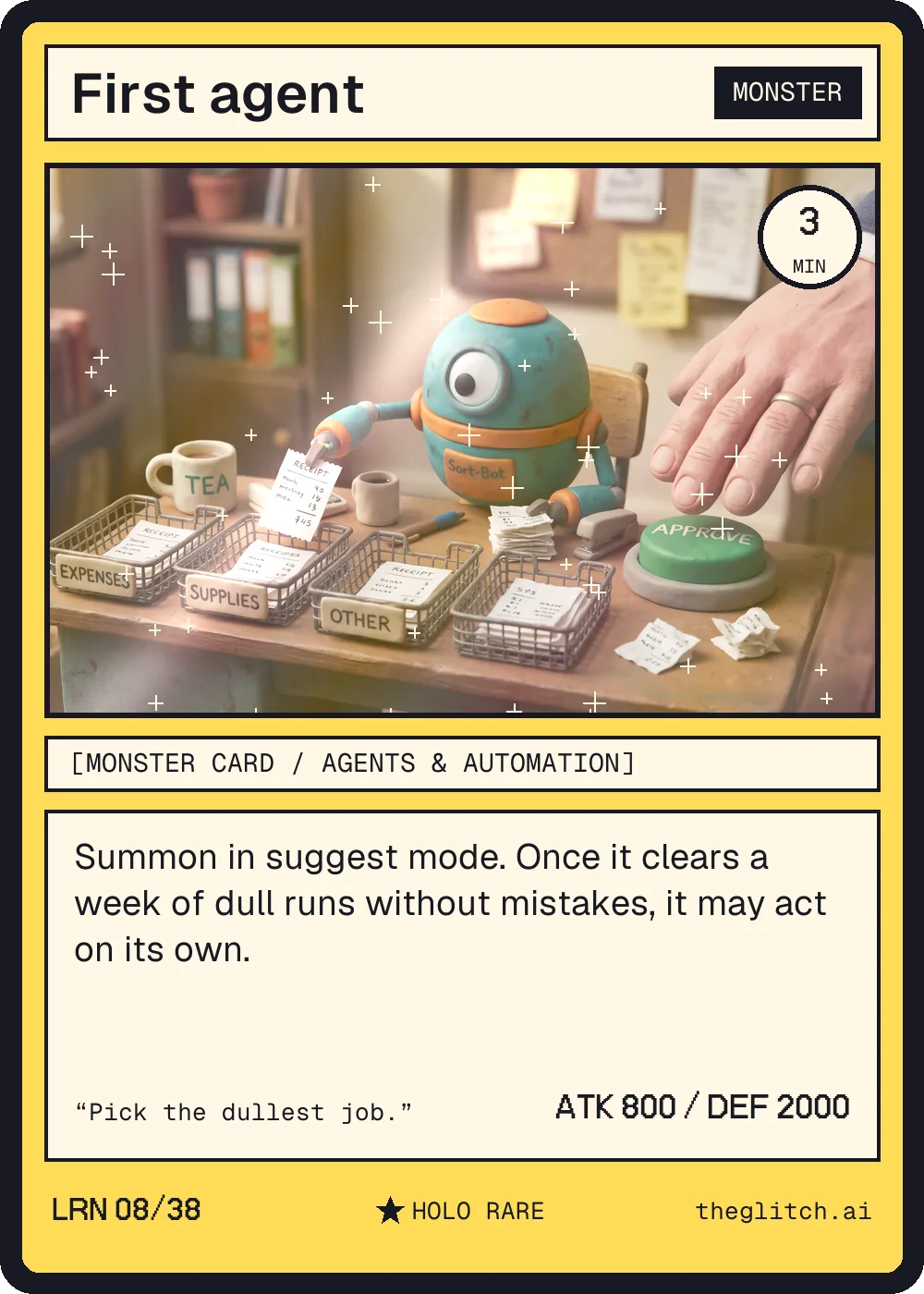
For the first two weeks, the agent drafts and a human approves (human in the loop). Track how often the human changes the output, and why. When approvals are mostly one click, take the human out of the low-risk cases first.
Step 6: Watch it like a new hire
- Log every run: inputs, steps, outputs and cost.
- Alert on failures, and on silence. An agent that stopped running looks exactly like an agent with nothing to report.
- Review a sample every week. Quality drifts when the inputs change.
What it costs
A small agent like the competitor monitor usually costs a few dollars a month in model fees, plus the platform. The bigger cost is your time: a day or two to build, then an hour a week of review at first. If it saves more than that, keep it. If it doesn't, kill it without guilt.
Where to go from here
When your first agent survives a month, read How AI agents fail in production before you build the second, and Lock down your agents before they act before you give one access to anything important. For the bigger picture, see AI agents, minus the hype.
Fresh from This week in AI
the biggest unlock in agentic building isn't adding logic.
it's deleting it
Questions people ask
What is a good first task for an AI agent?
A good first task is repetitive, low stakes, checkable and bounded. Examples from the guide include a daily digest of new support tickets, enriching leads with public company information, routing inbound email, turning meeting transcripts into action lists, and watching competitor pricing pages for changes. Avoid anything that messages customers, moves money, deletes data or needs judgment you can't describe.
How do I build my first AI agent step by step?
Start by writing a half-page job description covering the trigger, inputs, steps, output and how you'll know it worked. Build it as a workflow in a tool like n8n, Zapier or Make, using the model only for judgment steps. Add tools where steps vary, test on twenty real past cases, then run in suggest mode with human approval.
Should I build a workflow or an agent first?
Build a workflow first. Map the steps and put the model only where judgment is needed, such as summarizing, classifying or extracting fields. This version is cheaper, easier to debug and often good enough. Add agency only where cases need different steps, and then set hard limits on steps per run, spend and timeout.
What are common mistakes when launching a first AI agent?
A common mistake is making the first agent too ambitious, which turns it into a demo that quietly dies. In testing, expect the model to invent fields not in the source, websites to block scrapers, and inputs in unplanned formats. Another risk is silence: an agent that stopped running looks like one with nothing to report, so alert on both failures and silence.
How should I prepare for building AI agents in 2027?
Start now with one boring, bounded agent and learn the habits that carry forward. Keep your twenty tested cases as a golden dataset for every future change, log every run's inputs, steps, outputs and cost, and review a sample weekly. Stop giving agents access to important systems before reading up on failure modes and security.
Key terms
Agent · Workflow · Tool calling · Hallucination · Golden dataset · Human in the loop
Try it here
Skills and workflows · Repos worth building on