Prompting that actually works.
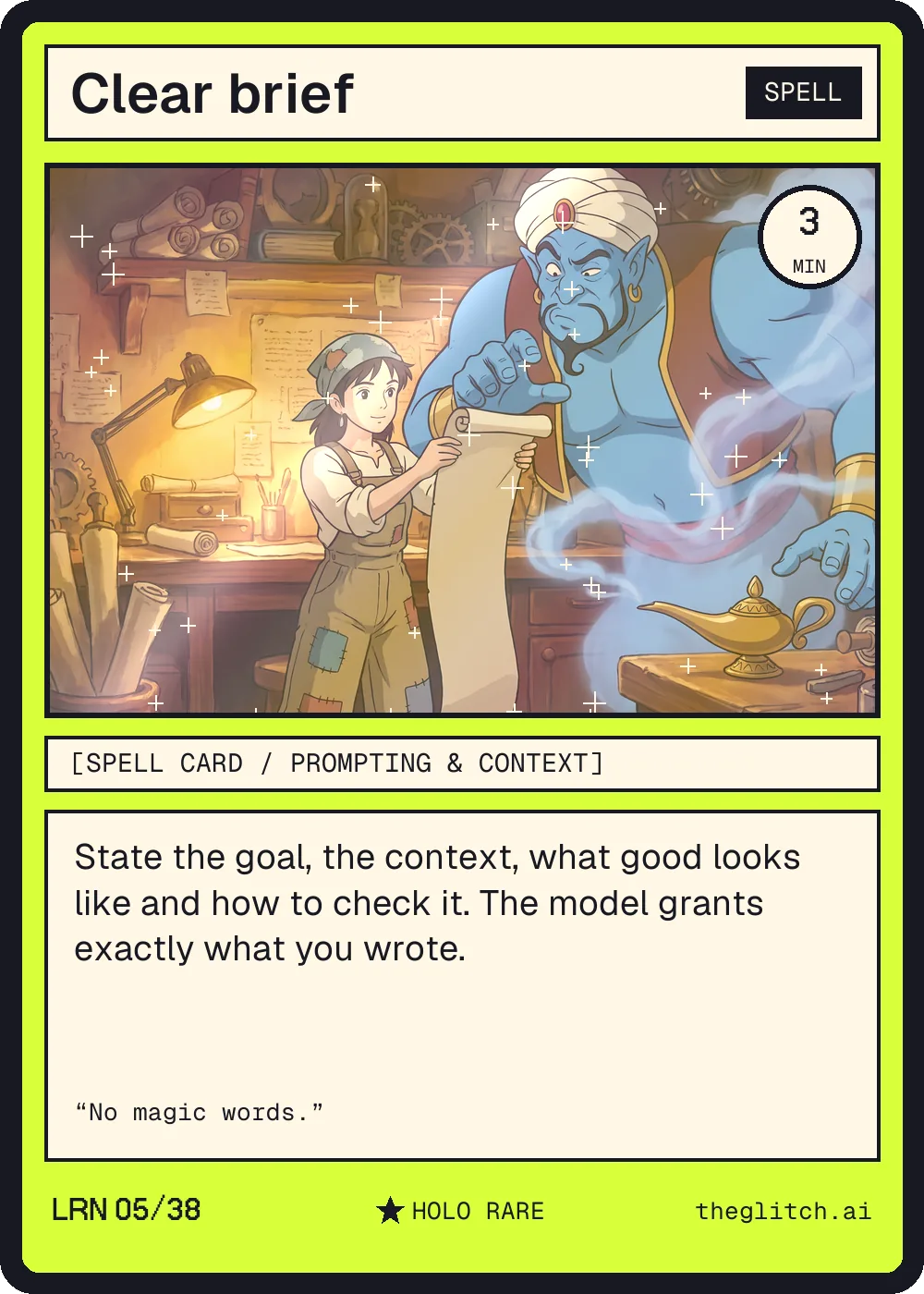
Forget magic words. Good prompts are clear briefs: the goal, the context, what good looks like and how to check it. Reusable templates included.
By Rabin Nuchtabek · Updated 2026-10-29 · 3 min read · For Beginner, Must know, Creators, Marketers
Part of What is a forward deployed engineer? The ultimate guide to becoming one in 2027
Prompt engineering got sold as a bag of tricks: magic phrases, all-caps threats, tips about tipping the model. Most of that aged badly. Modern models follow instructions well. What they can't do is read your mind. Prompting is briefing, the same skill as briefing a smart new colleague who knows nothing about your situation.
The brief: five parts
A good prompt answers five questions. You won't always need all five, but when an answer disappoints, one of them is usually missing.
- Goal. What are you trying to get done, and why? "Write a LinkedIn post" is a task. "Get founders who saw our launch to book a demo" is a goal.
- Context. Who's the audience, what do they already know, what's the situation? Paste the material: the notes, the data, the draft.
- Constraints. Length, format, tone, words to avoid, what not to do.
- Example. If you have an output you liked, show it. One good example beats a paragraph of adjectives (few-shot prompting).
- Success check. How will you judge the result? Ask the model to check its work against that before it answers.
Before and after
Weak: "Write an email about the project delay."
Strong: "Write an email to our client's head of marketing. The site launch moves from 3 June to 17 June because their payment provider's review is still pending. She's under pressure from her CEO. Goal: keep her trust and confirm the new date. Under 150 words, plain and direct, no apology spiral. End with the one thing we need from her: the provider's contact by Friday."
Same model. The second gets you an email you can send after a light edit.
Iterate like an editor
Treat the first answer as a draft and give feedback the way you would to a person: specific, and about the work. "Too formal. Cut the first paragraph. The deadline is wrong." Three to five rounds is normal. Past ten, the brief was missing something. Start a fresh chat with a better brief instead of arguing with a confused one.
Techniques that still earn their place
- Structure long inputs. Put documents first and instructions after, separated clearly with headings or tags (delimiters). Models lose track of what's instruction and what's material when it's one blob.
- Ask for a plan first. For complex work, have the model outline its approach before it writes. Fix the plan, then let it execute.
- Give it a role, briefly. "You're a CFO reviewing this budget" focuses the answer. A three-paragraph backstory doesn't add much (role prompting).
- Ask for a fixed format when a spreadsheet or software will use the answer: a table, JSON or a template (structured output).
- Chain big jobs. Research, then outline, then draft, then edit, each as its own step (prompt chaining). Each step is easier to check.
What to stop doing
- Typing "act as an expert" and nothing else.
- Threats, bribes and all-caps warnings. Current models don't need them, and the model makers' own guides recommend calm, precise instructions. Shouting can make a model overdo the thing you shouted about.
- Asking for "the best" anything without saying best for whom.
- Pasting your whole drive "for context". Relevant beats more. See Context engineering is the real job.
Templates worth keeping
Save the briefs you reuse as prompt templates, with blanks for whatever changes. Three that pay off in almost any job:
- Summarize for a decision: "Summarize [document] for [person], who has to decide [decision]. Give the three facts that matter most, the risks and what's missing. Flag anything you're unsure of."
- Critique my draft: "Here's my draft for [audience]. List the five biggest problems in order of impact. Don't rewrite it."
- Notes to plan: "Here are my notes from [meeting]. Turn them into owners, actions and dates. Mark anything that has no owner."
Test yours in the prompt workbench, and browse the prompt archive for more.
Questions people ask
What makes a good AI prompt?
A good prompt is a clear brief, the same thing you would give a smart new colleague who knows nothing about your situation. It covers five parts: the goal and why, the context and material, constraints like length and tone, an example of output you liked, and a success check the model should test its work against before answering.
How do I improve a disappointing answer from ChatGPT?
Treat the first answer as a draft and give specific feedback about the work, the way an editor would. For example: too formal, cut the first paragraph, the deadline is wrong. Three to five rounds is normal. If you pass ten, the brief was missing something, so start a fresh chat with a better brief.
Do magic words and all-caps threats work better than plain instructions?
No. Modern models follow instructions well and don't need threats, bribes or all-caps warnings. The model makers' own guides recommend calm, precise instructions. Shouting can even make a model overdo the thing you shouted about. Your effort is better spent on a clear goal, relevant context and a way to check the result.
Is pasting lots of documents for context a prompting mistake?
Yes, if you paste everything. Relevant context beats more context, so avoid dumping your whole drive into the chat. When you do include long inputs, put documents first and instructions after, separated clearly with headings or tags. Models lose track of what is instruction and what is material when it all arrives as one blob.
How should I prepare for prompting AI at work in 2027?
Build the habit of writing prompts as briefs now, and stop relying on magic phrases or vague requests like "act as an expert." Save briefs that work as reusable templates with blanks for what changes, such as summarizing for a decision, critiquing a draft or turning notes into a plan. Practice chaining big jobs into checkable steps.
Key terms
Prompt · Few-shot prompting · Delimiters · Role prompting · Structured output · Prompt chaining · Prompt template
Try it here
Prompt workbench · Prompt archive