AI voice agents worth knowing in 2027.
Vapi, Retell AI, Bland, Synthflow and ElevenLabs next to open-source Pipecat and LiveKit: what each does, how to choose and the risks to plan for.
By Rabin Nuchtabek · Updated 2026-11-04 · 2 min read · For Builders, Marketers, Leaders
Part of What is a forward deployed engineer? The ultimate guide to becoming one in 2027
A voice agent answers or places calls and talks like a person: booking appointments, answering support questions, qualifying leads. Under the hood it chains speech recognition, a model and a synthetic voice, usually on a phone line. Going into 2027 you can rent the whole thing as a platform or build your own with open-source frameworks. This directory covers both. Platform lines are each company's own description; GitHub numbers are from 4 November 2026.
Platforms that run phone agents for you
These handle the phone lines, voices and infrastructure, so you design the conversation.
- Vapi: "Voice agents for builders", a platform for building, launching and improving voice agents while it runs the infrastructure.
- Retell AI: a platform for automating phone calls with voice agents that talk, complete tasks and handle growing call volumes.
- Bland: "Voice AI for the calls that can't go wrong", for building, running and monitoring phone agents that handle sensitive conversations.
- Synthflow: voice agents for automated phone calls that answer, place and manage business calls, including routing, scheduling and support.
Beyond the phone
- ElevenLabs Agents: "Conversational agents that feel human", for building, testing and deploying agents across voice, chat and email on websites, apps and contact centers.
Open-source frameworks to build your own
Pick these when the voice agent is part of your own product and you want control over every piece.
- Pipecat: an open-source framework for voice agents, multimodal apps and realtime AI, maintained by Daily and the community. 17,030 stars, BSD-2-Clause, Python.
- LiveKit Agents: a framework for building realtime voice AI agents. 15,071 stars, Apache-2.0, Python.
- TEN Framework: an open-source framework for conversational voice AI agents. 11,220 stars; check its licence in the repository.
- OpenAI Realtime Agents: a demonstration of agentic patterns built on OpenAI's Realtime API. 7,015 stars, MIT. A good place to see how the pieces fit before you build.
How to choose
- High call volume, standard calls? A platform gets you live fastest. Run the same test script on two of them and compare how they handle interruptions and accents.
- Voice inside your own product? Start with an open-source framework so you own the conversation logic and the data path.
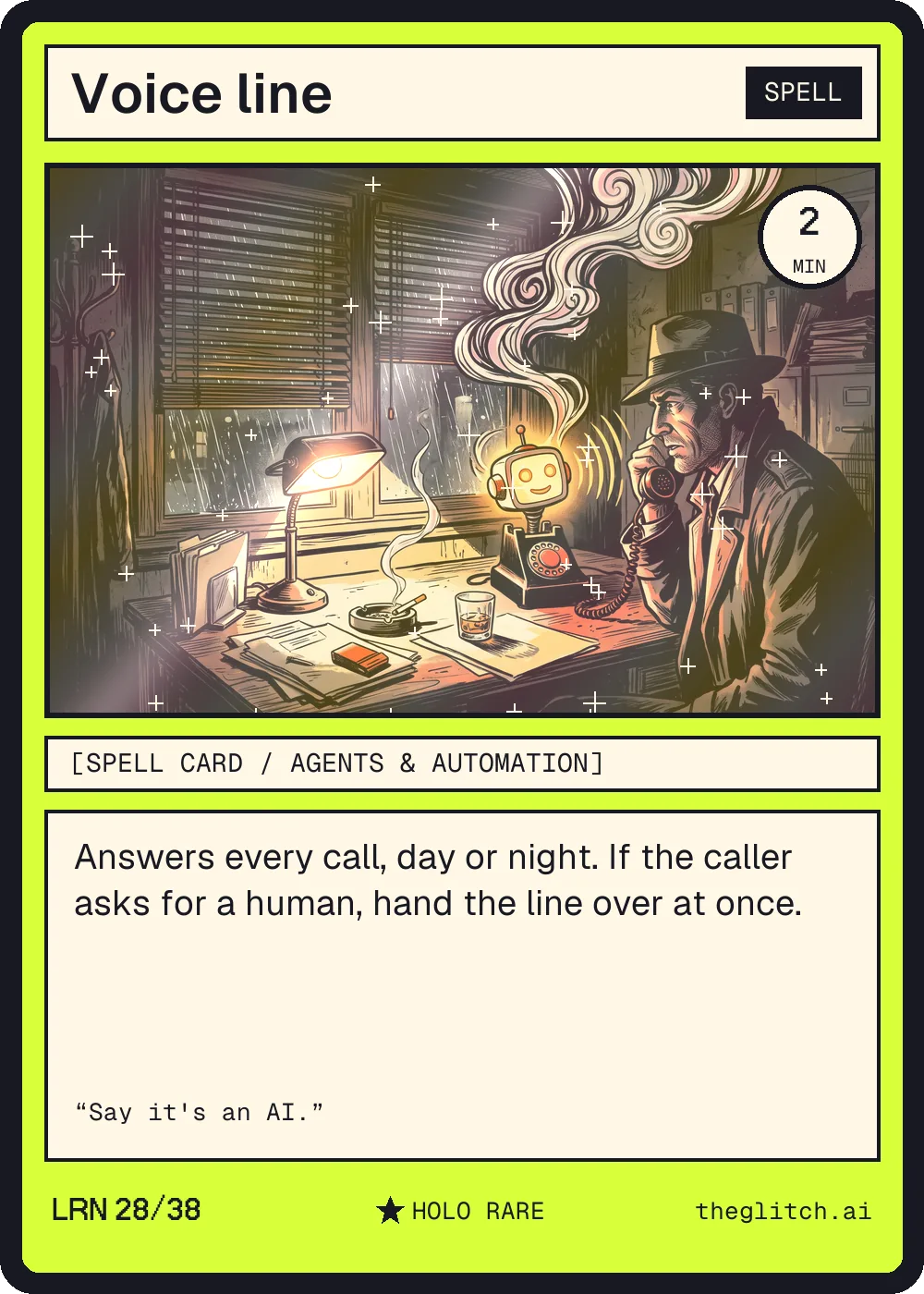
- Plan the handoff. Every agent needs a clean way to pass the caller to a human, with the conversation so far.
- Count the full cost. Platforms usually price per minute, and the model, the voice and the phone line can each add to it. Check each pricing page with your real call lengths.
Risks to plan for
- Callers can steer it. Anything a caller says goes into the model, so a caller can try prompt injection. Don't let a voice agent take irreversible actions without a check.
- Voices can be faked. Voice cloning and deepfakes mean a voice alone shouldn't prove who someone is.
- Calls carry personal data. Treat recordings and transcripts as PII: store them only as long as you need them.
- Say it's an AI. Tell callers they're talking to an AI agent. Rules on automated calls and recordings differ by country, so check yours before you go live.
New to agents? Start with AI agents, minus the hype, then Lock down your agents before they act.
Fresh from This week in AI
| What it does | Kind | |
|---|---|---|
| Vapi | Voice agents for builders | Platform |
| Retell AI | A voice agent platform for automating phone calls | Platform |
| Bland | Voice AI for the calls that can't go wrong | Platform |
| ElevenLabs Agents | Conversational agents that feel human | Platform |
| Pipecat | An open-source framework for voice agents and realtime AI | Open source |
| LiveKit Agents | A framework for building realtime voice AI agents | Open source |
Questions people ask
What is an AI voice agent?
An AI voice agent answers or places calls and talks like a person, handling tasks such as booking appointments, answering support questions and qualifying leads. Under the hood it chains speech recognition, a model and a synthetic voice, usually on a phone line. You can rent one as a platform or build your own with open-source frameworks.
How do I choose between voice agent platforms like Vapi and Retell?
Run the same test script on two platforms and compare how they handle interruptions and accents. Platforms suit high call volume and standard calls because they get you live fastest. Also count the full cost: platforms usually price per minute, and the model, voice and phone line can each add to it, so check pricing with your real call lengths.
Should I use a voice agent platform or Pipecat and LiveKit?
Use a platform if you want phone agents live fastest, since it handles the phone lines, voices and infrastructure. Choose an open-source framework like Pipecat or LiveKit Agents when the voice agent is part of your own product and you want to own the conversation logic and the data path.
What are the security risks of AI phone agents?
Callers can steer the agent, because anything they say goes into the model and can be used for prompt injection. Don't let a voice agent take irreversible actions without a check. Voice cloning and deepfakes mean a voice alone shouldn't prove identity, and recordings and transcripts should be treated as personal data and stored only as long as needed.
How should I prepare for deploying AI voice agents in 2027?
Plan the human handoff before the first call, so the agent can pass callers to a person with the conversation so far. Add checks before any irreversible action, treat recordings as PII, and tell callers they're talking to an AI. Rules on automated calls and recordings differ by country, so check yours before you go live.
Key terms
Agent · Voice cloning · Deepfake · PII · Prompt injection